Quo vadis, SA?

1'048 Antworten · 262k Aufrufe · gestartet 26. Sept. 2006 von Yoshikawa
Bilder klein
Antworten
92 Beiträge · seit 200623. Sept. 2008 · #761
@Virus Africanum,

Du wirst schon Recht haben, nur ist es ist eben nicht sicher. Im Zweifel kann man ja mal eine mail an den Urheber schicken, so halte ich es zumindest.
Remo Nemitz auf Google+ Reisezeiten
ThemenstarterGast24. Sept. 2008 · #762
Moin zusammen,

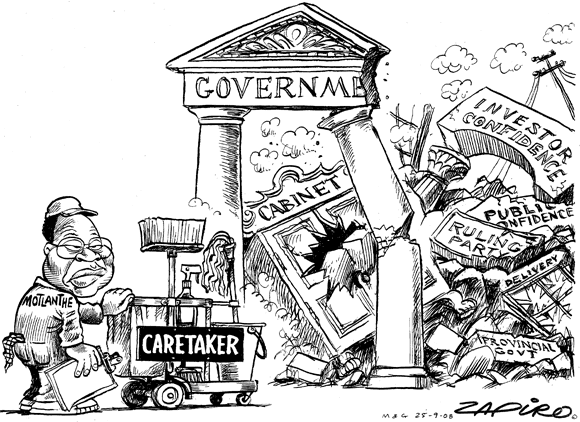
dass, was in Südafrika zurzeit vor sich geht, ist zwar ein massiver – und mittlerweile definitiv entschiedener- Richtungskampf innerhalb der herrschenden Partei, aber noch nicht unbedingt der Auslöser für den unmittelbaren Zusammenbruch dieses Staatswesens. Falls sich das Land in die WM hinein wird retten können, so werden die fünf Jahre danach die Geschwindigkeit der weiteren Entwicklung bestimmen.

Um zu verstehen, was in den letzten Wochen kulminiert ist, muss man weiter zurück in die Geschichte des ANC und seines Befreiungskampfes gehen. Der ANC ist über die Jahrzehnte seines Bestehens eine Xhosa-dominerte Befreiungsbewegung marxistischer Grundprägung geworden. Bereits zu Apartheidszeiten bestand ein Antagonismus zur Inkatha (http://de.wikipedia.org/wiki/Inkatha_Freedom_Party) der Zulu Herrn Buthelezis – einer seiner Freunde war ein gewisser FJS.

Allerdings hat es der ANC geschafft, eine weite Spannbreite politischen Empfindens abzudecken. Auf Deutschland übertragen hat er bis vor kurzem die Kommunistische Plattform Sahra Wagenknechts aus der Linken und den Wirtschaftsliberalen Guido Westerwelles eine Heimat geboten. Und nun hat SahraWagenknecht (http://de.wikipedia.org/wiki/Sahra_Wagenknecht), alias Jakob Zuma, eben Guido Westerwelle aus dem Amt geputscht. Worüber letzterer sicherlich froh wäre, da es bedeutete, dass er ein Amt gehabt hätte.

Warum nun ein derartiger Putsch so kurz vor dem Ende Mbekis Amtszeit? Was in der Diskussion der Gerichtsentscheidung untergegangen ist, ist die Tatsache, dass sie nur wegen eines Formfehlers bei der Anklageerhebung erfolgte! Es hätte somit erneut Anklage mit ungewissem Ausgang gegen Duschkopf-Zuma erhoben werden können. Aus diesem Grund war der nun erfolgte Putsch aus Sicht des Zuma-Camps reine Notwehr.

Dass es sich beim Feuern Zumas als Vizepräsident und der späteren Anklagen um eine rein politisch motivierte Handlung Mebkis handelte, halte ich für sehr wahrscheinlich. Interessant ist in diesem Zusammenhang die Behauptung der Sunday Times, Mbeki hätte von seinen Kickbacks aus dem Waffenhandel 90% an den ANC abgeführt und den Rest seinem damaligen Vize zur persönlichen Verwendung übereignet.

Der Machtkampf ist entschieden. Die 1994er-Konzilianz, personifiziert durch Nelson Mandela, hatte zunächst die zu erwartenden Lagerkämpfe innerhalb des ANC verhindert. Durch die Autorität Mandelas wurden zunächst auch SACP (http://de.wikipedia.org/wiki/South_African_Communist_Party) und COSATU (http://de.wikipedia.org/wiki/Cosatu) in Schach gehalten. Auch Mbeki schaffte dies zunächst, wenn auch nicht durch natürliche Autorität, sondern durch schiere Machtpolitik. Diese ist ihm nun ins Gesicht explodiert.

Schon 1994 hat der ANC den armen schwarzen Massen versprochen, dass sie bald in den Häusern der Weißen sitzen würden. Bei zwei weiteren Wahlen haben sich diese Menschen noch ruhig stellen lassen. Das ist nun vorbei!

Vorbei ist aber auch die Chance von 1994, nachdem sich die weiße Minderheit selbst entmachtet hatte:
- In den seitdem vergangenen 14 Jahren hat sie gelernt, dass sie im neuen Südafrika unerwünscht ist.
- Das Erbe einer Erstwelt-Infrastruktur ist von der Regierung in nur 14 Jahren verschwendet worden.
- Die Finanzmittel, den Forderungen der Armen nachzukommen, wurden (durch Korruption und WM) verschwendet und die Kreditwürdigkeit des Staates wird ebenfalls immer schlechter werden.

Gruß, Michael
ThemenstarterGast27. Sept. 2008 · #764
Moin zusammen.

Hier die Meinung des Militärs zu Trevor Manuel:
Army: Manuel has become too powerful and must be destroyed
PRETORIA. South African military commanders say Trevor Manuel, whose temporary resignation this week caused the Rand and the country's stock exchange to freefall, poses the greatest single threat to the country's future. According to senior officers in the Defence Force, Manuel has "mutated" and must be destroyed by a combined ground-, sea- and air assault.
http://www.hayibo.co.za/articles/view/872

Hier die der Kommunistischen Partei:
Nzimande on a possible ANC split (and other matters)
...
We are gathered here over this weekend proud of the fact that our Party, the South African Communist Party has grown both quantitatively and qualitatively. We must indeed be be proud of the fact that as we gather today the membership of our Party continues to grow. When we went to our 12th Congress in July last year, we had a membership of 52 651, and as of today we now have a membership of 70 606, representing a growth of 29% (17 955 new members) within a period of 15 months!
But we are not just growing in numbers, our prestige and influence amongst the workers and the poor of our country is growing, and even our enemies and detractors grudgingly concede to these qualitative advances made by our Party. However, this brings about further challenges and tasks to, amongst other things ensure that we focus on ideological development of our cadres, increase the payment of debit orders by members, intensify our mass activism, continue to build our policy capacity, and focus on priority questions facing our revolution on all fronts.
...
http://www.politicsweb.co.za/politicsweb/view/politicsweb/en/page71619?oid=104594&sn=Detail
Mbeki's Legacy
...
Mr. Mbeki was rightly praised for following good macro-economic policies that saw the budget deficit and public debt fall, and growth increase. But being reasonably tight with the public purse did not make Mr. Mbeki "business-friendly" -- as he was sometimes mischaracterized. Businesses in South Africa are heavily taxed (at 35%) and regulated. They also have to follow onerous race guidelines in employment and promotion. Micro-economic over-regulation has kept growth low (expected to come in at 2% this year) and contributed to a 26% unemployment rate. The number of people living in absolute poverty has doubled since the ANC came to power in 1994.
...
http://www.cato.org/pub_display.php?pub_id=9656

Für viele gibt es aber auch gute Nachrichzten:
Joy as Manto is chopped
There was singing in the streets on Thursday night at President Kgalema Motlanthe's announcement that Manto Tshabalala-Msimang was no longer health minister, but had been replaced by popular struggle veteran Barbara Hogan.
http://www.int.iol.co.za/index.php?art_id=vn20080926101155217C249819

Hier abschließend noch ein Zitat des neuen Präsidenten aus dem jahr 2000:
You must hate this system of Capitalism first and foremost. Because if you don't hate it you will not be able to engage in real struggles against this system.
(African National Congress Secretary General, Kgalema Motlanthe speaking at a rally on 1st May 2000)
Gruß, Michael
ThemenstarterGast28. Sept. 2008 · #765
Moin zusammen.

Heute etwas zur Ernährungssituation in Südafrika. Das Thema wird uns in Zukunft noch intensiver beschäftigen:
Starve, the beloved country
...
"In short, politics always get in the way of food security in South Africa. Instead of embracing experience and building on the strengths of our institutional memory, we destroy it on the grounds that it's apartheid memory or apartheid-supporting memory or just not the right ideological hue."

The emerging farmers are suffering the most from this, Burgess adds. "Hell, they've been hit by a double whammy. Trying to cope with the volatility of trade liberalisation, while dealing with a department of agriculture that doesn't have any capacity to support them. What chances do these guys have?
...
Public relations or not, the message is loud and clear. Agriculture in South Africa is crying out for leadership and support. If it doesn't happen, the big question is whether we will go the same way as Zimbabwe.

"The answer is 'yes' and 'no'," says Burgess. "In fact, in some ways we have already gone the way of Zimbawe. South African farms are being 'invaded' by criminals who steal, murder and thrive on lawlessness in a land where it is mostly pointless calling the police.

"Crime is so bad in the Free State along the Lesotho border that the farmers have appointed George Bizos to represent them in the constitutional court. Their case against the state is that it is not protecting its citizens from roving bands of foreign bandits who murder, steal their stock and wreak such havoc that they can't farm any more.

"When you can't farm any more, that's Zimbabwe.

"We also have official farm invasions here through legislation like the Mining Act, which makes an absolute mockery of property rights.
...
"We undoubtedly have some of the best farmers, researchers and agriculturalists in the world with more than enough expertise to turn things around. We have to start drawing on this expertise and we have to start supporting and respecting our farmers. They play an incredibly vital role in keeping our society stable.

"Without them we run the risk of running out of food and then we will start experiencing instability such as we have never known."
http://www.int.iol.co.za/index.php?set_id=1&click_id=13&art_id=vn20080928093632739C235350
King warns of food shortages
King Goodwill Zwelithini has warned of a serious shortage of food in KwaZulu-Natal if the department of agriculture and environmental affairs continues to be plagued with administrative scandals and infighting.

Speaking at the weekend, Zwelithini expressed deep concern that farmers in the province were not receiving necessary support because of the ongoing problems in the department.

"Something must be done with that department. It has one scandal after another and there is a lot of infighting.

"The department is shaking and there are no signs of improvement," the king said.

Problems in the department began in 2006 when it emerged that more than R80-million had gone missing.
...
http://www.int.iol.co.za/index.php?set_id=1&click_id=13&art_id=vn20080922104244322C473870
Vet graduates leave in droves
There is a severe shortage of veterinarians, with new graduates leaving the country in droves to take up more lucrative positions overseas.

Crime is one reason they cite for leaving, but also a need to make money to pay off the hefty student loans they need for the seven-year degree.

In rural areas the shortage is so severe that in some cases people are often forced to travel more than 100km to take an animal to a vet.
...
http://www.int.iol.co.za/index.php?set_id=1&click_id=13&art_id=vn20080920082354605C741584
South Africa: Food Security Under Threat
South Africans' food security - particularly the urban and rural poor, is under threat as they grapple with the highest food inflation rate in five years, according to the government's advisory body on agricultural marketing.
http://allafrica.com/stories/200809011619.html
SOUTH AFRICA: Maize - the unaffordable staple
JOHANNESBURG, 20 June 2008 (IRIN) - With global high food prices apparently here to stay, economists in South Africa warn that despite a bumper maize harvest, worldwide demand and soaring agricultural input prices mean that even maize-meal, the country's staple, could be off the menu.

Food prices in South Africa have risen by 15.7 percent since April 2007, and maize-meal – a stiff porridge, the starch of choice - had gone up by over 25 percent, Patrick Kelly, Consumer Price Index Manager at Statistics South Africa (STATSSA), told IRIN.

John Rook, Programme Manager of the Regional Hunger and Vulnerability Programme in South Africa, told IRIN that when over half the family income was spent on food, even a slight price hike on maize-meal could really hurt.

"The poorest are hardest hit; they spend the highest portion of their income on food," he said, and with meagre budgets already overstretched, "they can't keep on absorbing food price rises."

http://www.irinnews.org/Report.aspx?ReportId=78842

Gruß, Michael

www.mg.co.za
ThemenstarterGast03. Okt. 2008 · #766
Moin zusammen.
Investors see South Africa as too risky
JOHANNESBURG, SOUTH AFRICA -- It was a bit like a mouse trying to calm a herd of frightened elephants.

With both the world financial markets and South Africa's political scene in turmoil, the country's new president went on national TV Sunday promising to avoid any sharp changes in economic policy.
The morning after Kgalema Motlanthe's speech, the rand currency slid even further. Investors are shunning emerging markets as just too risky.
A speech by Reserve Bank chief Tito Mboweni on Sept. 18 starkly exposed South Africa's vulnerability to the global economic turmoil. About 18 billion rand ($2.16 billion) has flooded out of the country so far this year as foreigners sold off stocks.
http://www.latimes.com/news/nationworld/world/la-fg-africaecon30-2008sep30,0,3829996.story
Zuma’s rise puts whites to flight
The toppling of President Mbeki by a man with strong communist links has set off a new brain drain
...
Anna Davids, 62, an ophthalmologist, lamented: “There’s a whole generation missing. Look around. Where are the young white couples aged 25-45? At least two-thirds of them are gone.”
She said that affirmative action plans discouraged young whites from staying. “Everything’s loaded against young whites, no matter how well qualified they are.”
http://www.timesonline.co.uk/tol/news/world/africa/article4837796.ece
White flight from South Africa
FIRST he thought it was a mouse, then a rat—and then the rat shot him in the face. That is how André Brink, one of South Africa’s most famous novelists, described the recent killing of his nephew Adri, at home at 3am in the morning. The young man was left to die on the floor, in front of his wife and daughter, while his killers ransacked the house.
Such murders are common in South Africa. According to Mr Brink’s account, published later in the Sunday Independent, 16 armed attacks had already taken place in a single month within a kilometre of the young couple’s plot north of Pretoria, South Africa’s capital. Soon afterwards—this is more unusual—the police arrested a gang of six. They recovered a laptop and two mobile phones. That was the haul for which Adri paid with his life.
A decade-and-a-half after the end of apartheid, violent crime is pushing more and more whites out of South Africa. Exactly how many are leaving is impossible to say. Few admit that they are quitting for good, and the government does not collect the necessary statistics. But large white South African diasporas, both English- and Afrikaans-speaking, have sprouted in Britain, Australia, New Zealand and many cities of North America.
...
http://www.economist.com/world/mideast-africa/displaystory.cfm?story_id=12295535
SA slips in corruption index
Johannesburg - South Africa has slipped to position 54 in the Transparency International Corruption Perceptions Index (CPI) from position 43 in 2007.
http://www.fin24.com/articles/default/display_article.aspx?Nav=ns&ArticleID=1518-25_2398944
Namibia rutscht übrigens auch Jahr um Jahr, in diesem auf Rang 61.
South Africa: Dear Comrade Thabo Mbeki, It's Me Again
...
The purpose of politics in Africa is corruption. Power is merely an instrument of extending and facilitating corruption.
If you could invent a means of corruptly enriching elites that is divorced from politics, the African political elite would disappear in a night.
Think about Angola, Nigeria, Zaire, Kenya; why do you think there is deadly political competition? It's not about power per se, it's about the villa on the Riviera.Your country is like a fat, juicy, mongora, the queen of an anthill. With all that money from the Black Empowerment Programme and so on, I imagine every one-eyed idiot in the townships is fighting to get close to the inner sanctum of the ANC so that they can have a slice of the mongora.
After they have destroyed you, they will use the power of the party to destroy the country too. Once on the inside, they will fragment into tribal cabals and with the blood of the nation dripping from their fangs, they will devour the nation and its people -- and you.
...
http://allafrica.com/stories/200809280082.html
SA in literacy, numeracy crisis
Pretoria - Numeracy and literacy skills among grade three school children are unacceptably low, Education Minister Naledi Pandor said on Tuesday.
http://www.news24.com/News24/South_Africa/Politics/0,,2-7-12_2402117,00.html

Gruß, Michael
ThemenstarterGast09. Okt. 2008 · #767
Moin zusammen.
SA one of least safe places in Africa
But in the "safety and security" category, South Africa scored 61,1, and only six formerly war-torn countries scored lower. Ramphela said crime was under-reported, which meant the situation was probably worse than the 61,1 score.

She said law enforcement authorities were weak. "We have never managed to get on top of the crisis. If police files keep disappearing and cases don't make it to court, then you have a problem."

The culture of lawlessness was rampant, she said. The police were deeply corrupt - "no other country would tolerate having a police chief like Selebi remaining in his position".
http://www.iol.co.za/index.php?set_id=1&click_id=13&art_id=vn20081007060627680C711378
How competitive is SA?
South Africa has been rated the 45th most competitive country in the 2008/2009 Global Competitiveness Report (GCR), Business Unity South Africa (Busa) said on Wednesday.

This was one ranking lower than last year, when it was 44th out of 134 global economies surveyed and 10 down on 2005/2006, when South Africa was ranked 35th.

While it was still the highest ranked country in sub-Saharan Africa, Busa pointed out that Botswana had moved up 20 places, Namibia nine places and Kenya six.

"The GCR is clearly flashing some important warning lights for SA's future economic performance," said Busa economic consultant Raymond Parsons, who is the overall business convenor at Nedlac.
http://www.iol.co.za/index.php?art_id=nw20081008171605486C101175

Affirmative Action
Die nachfolgenden Zahlen und Beispiele sind dem Bericht “The current position of affrimative action“ auf http://www.solidaritysa.co.za/Home/home.php unter „News“ und dort unter „Latest Reports“ entnommen: –Auch die anderen berichte sind sehr informativ!– Der direkte Link ist: http://www.solidaritysa.co.za/download.php?file=The%20current%20position%20of%20affirmative%20actionENG.doc&
„…Affirmative action is based on designating certain people as groups that must get preference in certain areas, while designating others as groups that must not get preference. Affirmative action can only exist in such a scenario. If the “other” category falls away, affirmative action has no effect, as everyone is then included in the “preferred” group. Defining whites as the “other” group is problematic, because this group is so small. White males are only 2 196 300 of a total population of 48 687 000 people, or 4.5%. All whites as a percentage of the total population make up only 9.2%. At the moment, the ratio of white males to the rest of the population is 1:21.

In practice this means that only 4,5% of the positions South African labour market will be available for people of the designated group in South Africa, if all whites are removed from the labour market. Only a very small percentage of the designated group can benefit from this. Affirmative action is an effective instrument to help a minority, but an extremely inefficient instrument to help the majority. If 4,5% of the population has to correct the other 95,5% it simply leads to a feeling of alienation among the minority and a feeling of unfulfilled expectations among the majority. This is a powder-barrel about to explode. It is therefore simple: affirmative action in its current form fails because here are too little whites to discriminate against.

The key to any successful country in the modern world is knowledge. Those without knowledge and skills are left behind. In South Africa, partly because of injudicious transformation, the battle against poverty and unemployment is being undermined because of skills bottlenecks which are not unblocked. If the government is genuinely committed to halving poverty and unemployment by 2014 it will find it has no choice but to make use of all the skills it can possibly find.

Information about the following cases was provided by the Solidarity Institute for Constitutional and Labour Law Studies. The main points about each case is highlighted below.

• Reynhardt v University of South Africa (2008)
In this case, an inexperienced coloured person was given a job instead of a very experienced white male. At this time, the employer had already met its transformation targets and was still excluding the more-experienced white male using affirmative action.
The court found that in a case like this, where affirmative action targets had already being reached, an employer could no longer exclude a member of the non-designated group (whites) and use affirmative action as justification.
The employer was ordered to pay the white person 12 months’ compensation, as well as R661 000 in damages.

• Sibiya v Arivia.Kom (Pty) Ltd (unreported)
A person of the designated group claimed that she had been unfairly discriminated against when she did not receive the promotion that she applied for.
The court ruled that persons from the designated group could not claim unfair discrimination if they had not been considered for appointment or promotion after an objectively fair selection procedure, even if the job had gone to a person from the non-designated group.

• SA Engineering Council & another v City of Tshwane Metropolitan Municipality and another (2008)
Mr Weyers, a registered professional engineer employed by the municipality as manager of part of the municipal power control system, was responsible for the continuous operation of the power system. His job also included recruiting and appointing competent operators who were able to do the inherently dangerous jobs of working with the high voltage installations. A number of vacant posts occurred in his department. He had a test for applicants’ competency devised, which was approved by his superiors. The only candidates who passed the test were all white. Weyers’s seniors told him to remove them from the shortlist and to replace them with names of black applicants who did not pass the test. Mr Weyers wrote a letter to the Labour Department and to the SA Engineering Council in which he told of how the municipality appointed inexperienced people in jobs that were dangerous for themselves and which could create a danger for the public. In the letters, he pointed out that while affirmative action was necessary, the inexperienced black applicants should first have been appointed as trainees. As a result of these letters, Mr Weyers was fired from his job at the municipality. He went to the High Court for assistance.
The court found that Mr Weyers acted correctly in terms of all the applicable laws and that he had in fact been required by law to take steps to ensure safe operation of the power system. He had given more than enough justification for deviating from affirmative action in this case. The municipality was interdicted from imposing any sanction on Weyers for writing his letters.

• Martin Gordon v Department of Health: Kwazulu Natal (2008)
Mr Gordon was found to be the most suitable candidate for a certain job by a selection panel. Despite this, a black applicant was given the job. Mr Gordon approached the Labour Court claiming that this constituted unfair discrimination based solely on his race and colour. The Labour Court ruled that this was not the case. Mr Gordon then appealed to the Labour Appeal Court, who rejected the appeal.
The Supreme Court of Appeal found that the appointment of the black candidate in the absence of an affirmative action plan or programme was ad hoc and arbitrary. It concluded that the appointment of the black candidate discriminated unfairly against Mr Gordon.
...”
Gruß, Michael
zuletzt bearbeitet 09. Okt. 2008
ThemenstarterGast13. Okt. 2008 · #768
Moin zusammen.

Have more fun in your Ford!
How To Avoid a Hijack Situation
Approaching and entering your driveway:
• 2km from your house strategy. Be extra alert. Switch off the car radio and concentrate on your surroundings. If you have noticed any vehicle behind you, use the techniques you have learned during the hijack prevention & survival course to determine whether you are being followed.
• Remember to stop your vehicle just on the inside of the gate and select reverse whilst waiting for the gate to close. This creates confusion and may buy you a few seconds for the gate to close completely behind you.
• Check your driveway and street before you leave or enter your premises.
• Make sure your driveway is well lit and clear from shrubbery where perpetrators can hide.
• Be aware of unknown pedestrians close to your residential address – do not turn into your driveway – pass and go back later.
• Liaise with your neighbours – know them.
• Be aware of vehicles parked close to your address with occupants inside. It might be perpetrators observing the area.
• Be alert if your animals do not greet you at the gate as usual. It might be that the perpetrators over-powered them.
• Phone your home and ask for someone to make sure your driveway is safe and to open and close the gate for you.
• When returning home after dark, ensure that an outside light is on, or have someone meet you at the gate. Check with your armed response company if they are rendering rendezvous services.
• If at any time you have to open the gate yourself, switch off the vehicle, leave the key in the ignition and close the door. Then open the gate.
• If you have small children in the vehicle, take the key with you (this is the only exception). You need the key as a “negotiating tool”. The perpetrators want your vehicle and you want your children.
• If your children are older, it is advised that they exit the vehicle with you when opening the gate so that you are all separated from the vehicle should a hijack occur.
Parking your vehicle:
• Check rear-view mirror to ensure you are not being followed.
• When exiting your vehicle, be cautious and aware of surrounding obstructions and shrubbery that may be concealing a hijacker.
• Never sit in your parked vehicle without being conscious of your surroundings. Sleeping in a stationary vehicle is particularly dangerous.
• When approaching your driveway, be on the lookout for suspicious vehicles / persons. This is very important as the majority of hijackers approach their victims in home driveways.
Whilst entering your vehicle and while driving, the following should be considered:
• Have your key ready, but not visible.
• Inspect the outside and inside of the vehicle before unlocking. (Tyre, tyre, number plate, other side of the vehicle – as explained during the hijack prevention & survival course)
• Know your destination and directions to it; and be alert should you get lost.
• Always drive with your windows closed and doors locked.
• Make a mental note of any Police Stations in the vicinity.
• When stopping behind another vehicle, leave half a vehicle length in front of your vehicle to make an emergency escape if necessary.
• When dropping off a passenger, make sure they are safely in their own vehicle before departing.
• Avoid driving through high crime or unfamiliar areas.
• Avoid driving late at night / early hours of the morning when the roads are quiet.
• Drive in the center lane away from pedestrians where possible.
• If possible, never drive alone.
• NEVER, EVER pick up hitchhikers or strangers. (VERY IMPORTANT)
• Never follow routine routes when driving; change on a regular basis.
Other situations:
• If approached by a stranger while in your vehicle, drive off if possible or use your hooter to attract attention.
• Lock your doors, close your windows and do not have bags or briefcases visible in the vehicle. Use the boot for this. Cell phone should also not be visible.
• There are times and days that these items are visible in the vehicle. Try and open the window they might “smash & grab” about 3 cm, so the window can absorb the sudden impact. If you’ve left your stopping distance you may be able to escape.
• Be constantly on the lookout for suspicious looking characters or vehicles and do not hesitate to report them to the SAPS.
• Always be on the alert for potential danger, and be on the lookout for possible escape routes and safe refuge along the way.
• When approaching a red traffic light at night, slow down so that you only reach it when it turns green.
• Do not take anything from people standing at traffic lights or places where they gather (job seekers on gathering points). Perpetrators are usually standing among these people.
• Make sure you are not followed. If you suspect you are being followed, drive to the nearest Police Station or any busy public area.
• If any person or vehicle in a high-risk area arouses your suspicions, treat it as hostile and take appropriate action, e.g. when approaching a red traffic light, slow down, check for oncoming traffic and if clear, drive through the intersection. A fine will be preferable to an attack. Treat stop streets in the same way. Thereafter call for assistance if necessary. Always report these incidents to the SAPS. But remember, this is not an excuse to ignore the rules of the road. The onus will be on you to prove in a court of law that you had justifiable reason to act the way you did and this is only in the case of a real, life-threatening emergency.
• Should a suspicious vehicle in fact be a (unmarked) SAPS vehicle, the Police must identify themselves by:
o Use of a blue light, loudspeaker or any other police equipment.
o The flash of a badge through the window whilst driving is not enough.
o The Police must go all out in order to let the public know who they are.
• Consider the following actions:
o Switch on emergency lights and put your hand out the window (if possible), indicating that they should follow you. Your intention must be very clear and understandable.
o By exceeding the speed limit, you are sending out a message of suspicion, e.g. stolen / hijacked vehicle, transporting stolen goods, under the influence.
o Drive to the nearest Police Station or when in doubt, the nearest busy public area.
• Always have your identity document and driver’s license in your possession as well as a pen and notebook to take necessary notes.
• If possible, avoid driving in the dark. Hijackers may stage a minor accident, for e.g. If your vehicle is bumped from behind and you do not feel comfortable with the individual involved in the situation, indicate he / she must follow you and drive to the nearest Police Station or any busy public area for help.
• Never open your vehicle window or door for any stranger. If a suspicious person is near your unoccupied vehicle, do not approach the vehicle. Walk to the nearest public area and ask for assistance.
• If you encounter obstacles in the road, e.g. rocks, tyres, do not get out of your vehicle to remove them. Reverse and drive away in the opposite direction.
• Do not stop to eat or rest on deserted roads.
• Do not leave your vehicle unattended at a filling station.
• Cell phones should be carried on the body. Perpetrators will not allow you to remove your cell phone and valuables from the vehicle during an attack.
Information you should know:
If your vehicle is hijacked or stolen, promptly report it to the SAPS. Make sure you have the vehicle details: model, color, vehicle identification and registration numbers available to assist with the recovery of the vehicle.
When forced to drive with a hijacker, be observant without making direct eye contact and try to memorise as many details as possible. It is important to describe the hijacker as accurately as possible. When observing a hijacker, take note of his head and face – the shape of the eyes, mouth, nose and ears. Take note of possible irregularities. Look at the hair, skin color, complexion and possible scars and tattoos. Observe the build, sex, body movement, clothing and any conversation that may take place.
• Remember the direction from which they came and fled, as well as the time and place the incident happened.
• Remember to make mental and physical notes immediately after the incident to ensure accurate and detailed information for the Police investigation.
Taken hostage - It can be helpful to have a survival plan in the back of your mind should such an incident occur. It is difficult not to become paranoid about being taken hostage. However, it is just as easy to become complacent.
One very important fact to remember when being hijacked:
Should the conclusion of the drama be by way of armed intervention, and escape is not possible, immediately drop to the ground, remain still and obey the orders of the leader.
If confronted:
• Do not lose your temper, threaten or challenge the hijacker.
• DO EXACTLY AS TOLD BY THE HIJACKERS!
• Do not resist, especially if the hijacker has a weapon. Surrender your vehicle and move away. Try to put as much distance between yourself and the hijacker(s) as speedily as possible.
• Do not reach for your purse or valuables. Leave everything in the vehicle.
• Try to remain calm at all times and do not show signs of aggression.
• Be compliant to all demands set by the perpetrator.
• Do not make eye contact with the hijacker. He may perceive this behavior as a threat and retaliate aggressively.
• Keep your hands still and visible to the hijacker, so as to give him assurance of your passive content.
• Do not speak too fast (if you are able to talk) and do not make sudden movements.
• Gather as much information as possible without posing a threat.
How many people?
How many firearms and description thereof?
What were the perpetrators wearing (clothing)?
To which direction did they drive off?
Take note of the language they use (the accent).
• First phone the SA Police Service on 08600 10111. They will dispatch the medical services if needed. Other emergency numbers you could phone are 112 ANY Network (Vodacom+MTN+Cell C) or 147 Vodacom ONLY.
• Activate the vehicle-tracking device, if the vehicle is fitted with one.
http://www.ford.co.za/servlet/ContentServer?cid=1178822287188&pagename=Page&c=DFYPage

Gruß, Michael
ThemenstarterGast15. Okt. 2008 · #770
Kapstadt wird ja auch nicht vom ANC regiert 😄
2'612 Beiträge · seit 200715. Okt. 2008 · #771
Lies mal den letzten Satz:

Das besagte Eastern Cape dürfte vom ANC regiert werden - aber vermutlich handelt es sich um eine Einzelmeinung, die in Deinen Augen nicht zu zählen ist...
Bye bye Forum
1'036 Beiträge · seit 200615. Okt. 2008 · #772
@ Volker und yoshi

Ich will mich nicht zwischen euch drängen, aber.....

Das ist doch ein Reiseveranstalter Beitrag ??? oder ???

Wenn ich Reiseveranstalter wäre, würde ich auch so positiv schreiben um mehr Touris anzulocken die zurecht verunsichert sind.

Fakt ist und bleibt, Krimanilität ist extrem hoch.... Respekt vor Leib und Leben fast Null.

Da helfen auch solche Beiträge nicht. Die Nachlässigkeit der Justiz und Polizei its hier das Hauptproblem.

Ich habe Augen und Ohren, fehlt dort !!!!

Zieh mal deine rosa Brille aus und schaue der Wirklichkeit in die Augen

Es ist und bleibt eine Reise wert, aber mit mehr Vorsicht Wachsamkeit und Abstrichen als vor der unfähigen und korrupten ANC Herrschaft.
HOME mit Afrika Links http://www.dersofaladen.de/home/ www.dersofaladen.de
2'612 Beiträge · seit 200715. Okt. 2008 · #773
Hallo Georg,

ohne hier wieder eine Diskussion über Brillenfarben in Gang zu treten - es geht mir lediglich um eine differenzierte Betrachtung der Situation. Und da gibt es tatsächlich noch Leute in SA, die ihre Wohnungstür nicht abschließen...

Ich werde ansonsten zu dem Thema hier nicht mehr diskutieren, sondern Artikellinks posten, wenn sie mir gerade "vor die Flinte" kommen.

Viele Grüße,

Volker
Bye bye Forum
843 Beiträge · seit 200815. Okt. 2008 · #774
Man könnte wirklich meinen, dass das ein nicht so ganz unabhängiger Beitrag im genannten online-Magazin ist (wie gesagt "man könnte" = Konjunktiv II).
Das scheint offenbar immer mehr in Mode zu kommen, vgl. z. B. Bericht über Zoos in D im Stern (m. E. eine einzige PR). An die Unabhängigkeit der Medien glaube ich schon lange nicht mehr.

Zurück zum Thema: Wir würden gerne mal ins östliche Südafrika, also an den Indischen Ozean. Wie sieht es da eigentlich aus bzgl. Sicherheitslage für Touris? Wir waren 2006 in SA (Krüger NP, Kapstadt, Garden Route) und die Berichtslage der vergangenen 2 Jahre hat uns davon abgehalten, wieder hinzufliegen. Haben wir übertriebene, "mitteleruopäische" Sorgen?
Gut, Namibia und Botswana waren ja "auch ganz nett" 😄 !
Grüße
Dirk
0
zuletzt bearbeitet 15. Okt. 2008
1'036 Beiträge · seit 200615. Okt. 2008 · #775
@ Matou66

Der indische Ozean ist ein weiter Begriff

Beginnt schon relativ nahe zu Kapstadt

Die Frage, wo liegen die Interessen ???

Beliebt ist:

Garden Route, Outshorn, Knysna, Wilderness, Plettenberg Bay, Port Elizabeth weniger ( ich mags aber)
Addo Park, East London bis Durban

Wo auch immer, es gibt Bademöglichkeiten bei angenehmen Temperaturen.
Sicherheit ist wie überall. Belbter strand kein Problem, abgelegene Buchten meiden, vor allem bei Einheimischen informieren welche Strände sicher sind in Bezug auf das Meer.......Es gibt Strände die harmlos aussehen aber meistens ertrinken dort nur Touries aus Europa. Es gibt ZB Strömungen/Unterströmungen die man unterschätzt
( Spreche aus eigener jahrelanger Erfahrung)

Zuerst mal sehen was die Südafrikaner machen und raten

Port Elizabeth zB zählt das Kingsbeach als relativ sicher, auch der Strand in East London. Mir war bisher noch kein Hai begegnet. In Durban beginnt dann das Hai Risiko.

Erkundigen vor Ort, wo, wann, was

Frage auch die Jahreszeit ???

Auch zu beachten ist: Ab Port Elizabeth Richtung Osten, besteht Bilharzia Gefahr an Flüssen.

Ich würde die Reise machen !!!!!
HOME mit Afrika Links http://www.dersofaladen.de/home/ www.dersofaladen.de
94 Beiträge · seit 200715. Okt. 2008 · #777
Hallo,
@ Matou66, Georg:

aber hinter Durban geht es doch noch weiter:
Hluhluwe-Umfolozi Game Reserve (ca. 280km nördlich von Durban),
iSimangaliso Wetland Park (bis letztes Jahr auch offiziell unter "Greater St. Lucia Wetland Park" bekannt)

und noch 'ne ganze Menge kleinerer parks oder reserves ....
Es lohnt sich auf alle Fälle!!
Aber ich geb' zu, bzgl. der Sicherheitslage bin ich nicht auf dem neuesten Stand; war 2004 dort und hatte keinerlei Probleme.

Grüße,
Heiko
0
zuletzt bearbeitet 15. Okt. 2008
843 Beiträge · seit 200815. Okt. 2008 · #778
Danke an alle!
Werde das Thema Route und Sicherheit nochmal in e. neuen Thread aufgreifen. Bis Knysna waren wir im Oktober 2006 schon mit dem Auto.
Wir fliegen im August '09 wieder für 22 Tage nach Nam/Bot, könnten aber im Mai für 245,-€ p.P. nach Joburg fliegen (hin und zurück!). Sind etwas hin- und hergerissen... .
Grüße
Dirk
0
94 Beiträge · seit 200715. Okt. 2008 · #779
Für 245,-€ ? p.P. ? Hin- und zurück ?
Wie ? Wo ? Womit?
Wo kann ich das buchen ?
Grüße, und schon 'mal Danke,
Heiko
0
843 Beiträge · seit 200815. Okt. 2008 · #780
@ HeikoSchmidt

Hast 'ne PMS 🙂 !
0
Dieses Thema ist geschlossen — neue Antworten sind nicht möglich.