Food crisis to be put before Cabinet Measures to stem the looming food price crisis in South Africa will be put before Cabinet next week, the National Agricultural Marketing Council (NAMC) said on Friday.
Nachstehend habe ich den Link zu einem Buch eingestellt, das sich mit den Folgen der Landumverteilungspolitik der südafrikanischen Regierung befasst. Wieder einmal bitte ich Euch: Schlagt den Boten (hier den Buchautoren) nicht für die Botschaft. Das buch ist keine ideologische Abhandlung, sondern eine schockierende Fallsammlung. Im Zusammenhang mit den schwindenden Lebensmittelreserven der Welt und den steigenden Lebensmittelpreisen ist es in meinen Augen ein „J´accuse“ gegen die Regierungen des südlichen Afrikas, denn auch in Namibia produzieren enteignete oder aufgekaufte Farmen weder Überschüsse, noch generieren sie Deviseneinnahmen oder Steuern. http://greatsalandscandal.blogspot.com/ Aus Kapitel 16 – Slaughter – The Farm Murder Plague:
The murder rate among South African commercial farmers (who are not all white) is the highest for a specific group in the world – 313 per 100 000. In his keynote book “Farm Attacks and the African Renaissance”, Professor C.J. Moolman outlines the role of land in traditional Africa. He succinctly defines the basic polarity between Western and African cultures. “The livelihood of Blacks has traditionally been, and is currently still in rural areas, intricately connected to their system of land tenure. They erect their dwellings on the land, cultivate it, graze their livestock upon it, and hunt over its surface.” “They use its water for domestic purposes and for their herds and flocks. They eat the wild fruits and other fruits it produces, and make medicines from its vegetation. They convert its wood into huts, palisades and various utensils, and its reeds and grass into basket-work, thatch and string, and they extract from it metals, clay for their pots, and earth for the floors and walls for their huts.” This describes traditional Africa. But traditional Africa cannot feed itself. There is not one single African country self-sufficient in food. They have to depend on the West for survival. And the West has a completely different approach to food production, and to life itself. This cultural dichotomy unfortunately occurs in one country – South Africa – and the contents of this book shows clearly that Western commercial farming has rescued South Africa from the fate which befell the rest of the continent.
Inflation sinks millions deeper into poverty In the three-year legal case, ACESS argued that desperately poor children had been denied grants either because they did not have birth certificates, or their parents or caregivers did not have IDs.
The Home Affairs Department has been fingered for alleged incompetence and the massive hurdles encountered in getting official papers.
Some people have been found to be too poor to even afford buying ID photos for application forms.
Wheat Crop Failures Could be Total, Experts Warn According to the Food and Agriculture Office (FAO) of the United Nations, approximately a quarter of the world’s global wheat harvest is currently threatened by the fungus. Meanwhile, global wheat stocks are at lows not seen in half a century, according to the U.S. Department of Agriculture. Scientists fear that the spores could spread on the wind and reach the U.S. and Canada or Europe.
Kempton Park power cut causes havoc A power cut that is expected to last for five days has brought disaster to businesses and greatly inconvenienced families in Kempton Park. The area battled for the second day without electricity on Thursday after a fire at a substation.
Eskom discussing recent blasts Last Friday, power surges caused by electricity cuts resulted in an explosion at a Port Elizabeth substation. The Nelson Mandela bay municipality said oil-based circuit breakers at the substation exploded, causing damage estimated at millions of rands.
Collapsing power grid is 'lethal' - SA engineers April 25 2008 - Eskom, South Africa's state-run utility, 'is in discussions' with all the municipalities that have experienced fire blasts since power cuts began, the state-owned utility 's spokesman says.
It's not sure what would be accomplished with such 'discussions", as the state-owned company's ANC-appointees continue to ignore the basic problem: they live in luxury and reward themselves huge bonuses while ignoring the need to maintain and modernise the electricity network -- which now is being described by one Cape Town maintenance engineer as 'lethal'. http://www.solidaritysa.co.za/Home/wmview.php?ArtID=1227
This careless attitude comes from the very top of SA's corrupt autocratic pyramid: • SA's president Thabo Mbeki publicly admitted last year that he had been wrong when he had denied ESKOM extra funding five years ago - however since this apology, he has done absolutely nothing to correct the problem. • On the contrary, he has continued to support ESKOM's policy of firing skilled electricity engineers only because they are white. http://www.solidaritysa.co.za/Home/wmview.php?ArtID=1218 Now lives are being lost because of the steady collapse of ESKOM's electricity grid and the skills-exodus from the company. The massive grid was the most efficient in Africa fourteen years ago. It was installed all over southern Africa during the apartheid-era (which ended fourteen years ago).
Insultation, underground cables, transformers, and oil-circuit breakers now are all collapsing steadily like a massive network of dominoes - and people are being killed because of it.
Friday's explosion at a substation in Walmer, Port Elizabeth happened because the circuit breakers were not designed to be switched on and off at regular intervals in a system of 'rolling blackouts' to 'conserve electricity'.
Local network engineer Lourens Schoeman said all the circuit breakers in the municipality must be replaced -- but this would cost about R50million and they don't have the money for that. • "We do the normal maintenance but we just don't have that kind of money available." And this problem is seen all over the country: four days after PE's explosion, Kempton Park in Johannesburg was hit by a major power failure when a substation in the central business district went up in flames.
Charles Kadalie, manager for public lighting for the city of Cape Town, said the problem has been a long time in coming.
"Late last year we had an explosion in one of our substations and there were five of our staff in the substation when it exploded," he told News24. "One died, and three of them were critical in hospital."
Kadalie explained that along with 'ageing' equipment, the "abnormal" situation of ESKOM's blackout-system which they refer to in ANC-speak as 'load-shedding', puts extreme strain on infrastructure.
"The fact of the matter is [load shedding] is causing a lot of stress and strain countrywide on the electricity grid and the electricity network," said Kadalie.
He pointed out that electricity networks were designed so that they could keep on growing. "This (load-shedding) is a complete reversal of what you are trained to do," he said. "It's the kind of things that you don't really factor into your planning."
Kadalie listed underground cables, transformers, and oil circuit breakers as things that are taking strain they had not been designed for due to the increased pressure from load shedding.
"The insulation goes, gasses are being formed in your oil circuit breakers and your transformers and before it settles you're switching it back on again."
Move over, energy and food crises The South African fuel industry is facing a crisis that is going to make Eskom's problems look like a picnic, the Fuel Retailers' Association (FRA) says.
Angry commuters torch rail offices Commuters, angry at the late arrival of trains, resorted to burning the Metrorail ticket sales office and pelting a train with stones.
Goods train with three locomotives and eight coaches which derailed between Benoni and Springs on the Johannesburg East Rand, after thieves stole railway track last week. Transnet reports that several metres of track is stolen daily yet nobody lifts a finger to put an end to it.
Gruss, der K l a u s
Nicht behindert zu sein ist ein Geschenk, welches einem schnell genommen werden kann....... In einem Augenblick! ......
Wer einen Fehler macht und ihn nicht korrigiert, begeht schon den zweiten...
SA compared to Zim's early days South Africa could be plunged into serious political instability similar to that in Zimbabwe, SA Communist Party Deputy General-Secretary Jeremy Cronin has warned.
End of a credible South Africa Tourists started getting raped during office hours, CNN journalists were shot at, and foreign diplomats' homes were being burgled and the world scratched their heads in confusion. Others started nodding their heads, muttering awful things like "this is what you get if you don't have a proper civil war and merely sign some papers instead" and "it's Africa after all, what else did you expect?".
Das folgende Problem ist aber nicht auf Zimbabwe oder Südafrika bschränkt:
Africa's Leadership Crisis The Case of Zimbabwe The Namibian Friday, May 2, 2008
HIDIPO HAMUTENYA THE crisis in Zimbabwe goes on without abatement.
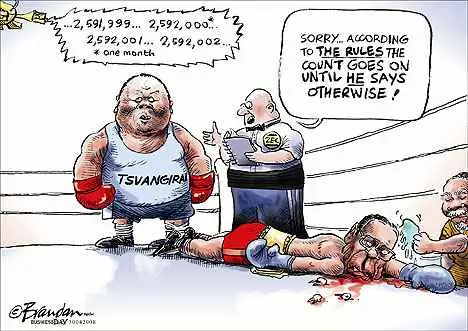
As we go to press, the presidential results of the now one-month-old election in Zimbabwe remain unknown.
This is fundamentally a manifestation of the persistence and intractable problem of a leadership succession crisis in Africa, a crisis that has been besetting Africa since the advent of the main wave of independence at the beginning of the 1960s.
Soon after the achievement of independence, the process began to unfold whereby political parties in Africa became mere fiefdoms of their party bosses.
And the broad masses of followers, whose political enthusiasm and energy had been aroused during the struggle for independence, found themselves held hostage to the patronage of the party bosses.
Also, in the absence of internal party democracy, parties began to largely fulfil the role of being instruments of the political ambitions of their leaders, whose preoccupation was now to stay indefinitely in power.
The constitutional provisions that restricted the office of presidents or prime ministers to a specific number of terms (mostly two) had to be subverted so that leaders could prolong their staying in power.
The avenue to democratic and peaceful leadership succession became blocked by the then emerging civilian autocracy and military dictatorship, which ascended to power through coups.
Political instability eventually became the order of the day.
To remove the entrenched autocratic dictators and military rulers became a formidable task, holding back socio-economic development and progress in Africa.
In Zimbabwe, President Robert Mugabe has been one of the civilian autocrats who has been in power for 28 years, tolerating no rivalry to his power.
His political desire to stay in the presidential office remains insatiable and unconstrained by conscience.
Hence, the repeated flare-up of that crisis.
As African leaders devote their attentions and efforts to clinging to power, our continent continues to endure the burden of underdevelopment, widespread poverty, high levels of illiteracy, widening income gap between the haves and have-nots, etc.
The end of the Cold War, namely, the ceasing of the once sharp ideological division between the East and West, at the beginning of the 1990s appeared to herald an era of democratisation on the continent.
The phenomenon of military coups d'etat, an undemocratic way of bringing about leadership succession in Africa, seemed to be on the decline, as various forms of multiparty political systems were being introduced around the continent.
But the introduction of multi-partyism did not prevent the leadership succession from developing into an acute crisis on the continent.
With military coups being widely discredited, gaining and clinging to power now took the form of civilian dictatorship, that is, self-entrenched autocratic rule via different forms of intimidation, election rigging and many other forms of undemocratic cheatings.
These dishonest methods of leadership succession often led to violent conflicts.
African autocrats did not hesitate to tamper with their national constitutions to prolong their stay in power.
Among the recent cases of succession-driven crises in Africa are those of Sierra Leone, Ivory Coast, Liberia, Togo, Kenya and Zimbabwe.
Thousands of lives have been lost due to the destructive nature of these conflicts.
Another aspect of the leadership succession crises in Africa is that of African heads of state stepping down from the presidential office but manoeuvring to desperately cling onto a certain measure of power by remaining leaders of their political parties.
The most recent examples are those of Namibia and Malawi.
In the case of Namibia, the constitution had to be amended to accommodate a third term for the former president, Sam Nujoma, only.
In Malawi, Nigeria and Zambia, similar attempts were made to amend the constitutions, but these were thwarted by a coalition of forces made up of opposition political parties, civil society organisations, and even sections within the ruling parties.
The ambitions of Bakili Muluzi, Olusegun Obasanjo and Frederick Chiluba, in their attempts to amend the constitutions of their respective countries in order to extend their terms of office, were shameful because all these men came to power masquerading as born-again democrats.
In Zimbabwe and Uganda, opposition parties and civil society organisations failed to stop the incumbent presidents Robert Mugabe and Yoweri Museveni from amending their constitutions in order to extend their terms of office.
Hence these two autocrats succeeded to extend their stay in power.
And this why the crisis of leadership succession is continuing to brew in those two countries.
The succession issue engendered a constitutional crisis in Ivory Coast resulting in a military coup, electoral fraud, civil unrest and subsequent division of the country into the south and the north.
In Togo, a succession crisis ensued in 2005 following the death of that country's former military strongman, Gnassingbe Eyadema, and the military installation of his son, Faure Gnassingbe.
Because of the ongoing crisis of leadership succession, Africa has just witnessed carnage in Kenya.
Now we are seeing the inexorable deepening of a similar crisis in Zimbabwe.
In all these instances, countries did not only lose lives and property, but the process of democratisation has also been rolled back.
Development and socio-economic progress took the back burner to the self-serving, blind and egotistical ambitions of some of these leaders.
As a consequence, Africa lost decades of opportunity to overcome poverty and its current global marginalisation.
This happened as Asia and other developing regions were making quantum leaps in their economic growth and development.
In the light of these crises, African leaders must adopt a paradigm shift regarding their style of governance in the continent.
They must resolutely strive to oppose those who seek to cling to power through electoral rigging and attempts to change constitutions to suit their greed for political control and self-enrichment.
Africa must adhere to constitutional governments, respect for human rights, and respect for the rule of law, inclusiveness and freedom of expression and association.
This is what ideologically distinguishes the position of the Rally for Democracy and Progress from that of those who advocate the reactionary and archaic notions of ''guided democracy'' and no regime change.
Africans must shame and reject the autocratic style of leadership in order realise a bright and just future for our continent.
This is our unfailing duty and historic responsibility.
* Hidipo Hamutenya is a former MP and the leader of the RDP.
Is SA in a disaster zone? South Africa could be facing a disaster as food and petrol price increases rock the economy - unless urgent measures are taken, experts have warned.
Filthy municipal water did cause 78 babies' death - report confirms: How safe is your municipal water? May 1 2008 - Faecal water contamination was definitely the main factor in the deaths of some 78 babies of Barkly East, Maclear, Sterkspruit and Elliot in the Eastern Cape, the provincial government has now confirmed in a confidential report The babies had died of renal failure due to severe diarrhoea which was caused by the municipality's sewerage-contaminated water. An official health report, tabled two weeks at a closed (why?) council meeting, indicated there had been 'a breakdown in the water purification works' in October last year. Yet the municipality for two months had done nothing -- until 15 baby deaths were reported. The municipality in turn blamed the Cloete Joubert Hospital in Barkly East for 'failing to report the deaths in time for a proper investigation". They also blamed the staff for not having enough infravenous supplies on hand to treat the babies in time. However a senior hospital manager reiterated by noting that the municipality did nothing until 15 deaths were reported and that the present condition of the municipal water supply remains 'unsafe'. http://www.beeld.co.za Skilled white engineers fired: This problem is occurring all over South Africa because the country's border-to-border municipalities have now fired most of their white engineering staff and replaced them with unqualified black ANC-cronies under their so-called 'black economic empowerment' programme. Recently in Soweto, a cholera outbreak was reported which killed two people -- who were, as it turned out, infected with a new form of drug-resistant cholera. The squatter camp was supplied with municipal tap water piped in from Johannesburg.http://www.solidariteit.co.za
danke für die uploads! leider gibt es immer noch zu viele reisende und auch migranten aus DE nach SA, die die schweldenden brandherde einfach nicht wahrhaben oder zur kenntnis nehmen wollen. doch ich denke, augen verschliessen hilft da wenig! solche threads gehören in ein solches forum! doch die geringe traffic erstaunt mich.
den tatsächlichen Traffic anderer Foren kennen doch nur deren Admins. Ich habe bisher noch keins gefunden, welches auch die Zugriffzahlen auf die einzelnen Threads publiziert. Wenn Du Dir andere Foren zum südlichen Afrika anschaust, dann siehst Du, dass hier in allen Bereichen erheblich mehr los ist.
Over the long weekend burglars climbed into the roof of President Thabo Mbeki's official residence Mahlambandlovu on the Bryntirion Estate in Government Avenue in Pretoria and stole between R20 000 and R30 000 worth of aluminium.
ZIMBABWE: MAJORITY OF SADC LEADERS ARE CORRUPT AND POLITICAL HYPOCRITES Date Posted: Tuesday 06-May-2008 I thank all the people who are working for change in Zimbabwe. l encourage you to continue informing the world about torture, state-made starvation, serious human rights abuses and wide spread murder in Zimbabwe. Since the State sponsored violence that started after 29 March 2008 (with new dimension) more than 20 people have been murdered. More than 5 000 people have been displaced from their homes. In rural parts of the country houses of people who did not vote for the ruling ZANU PF government continue to be burned down. Now we are on the brink of genocide. That is how it started in Matabeleland genocide in 1983.
I don't think most of SADC leaders will do much to stop genocide in Zimbabwe or bring freedom and justice in this so-much troubled land. Many African leaders fear change in Zimbabwe. South African president Thabo Mbeki is also among those afraid of change in Zimbabwe. Mbeki has proved to be a political hypocrite as far as the Zimbabwean humanitarian crisis is concerned. How can a leader like him say, "There is no crisis in Zimbabwe?" Is that not hypocrisy?
All these years Mbeki has been playing political games – lying to the Western world and pretending as if he had a solution for Zimbabwe. I will never trust the ANC. What is the basis of hope in them? Failures, sympathizers of a murderous government (Mugabe's ZANU PF); pretending to be working for a change in Zimbabwe. Good the world has managed to see it now. That has been my call for the past 3 years.
Please may all people forget about Mbeki, he is just an insult to patriotic Zimbabweans. Even a shame to the whole African Community. People often forget that Mbeki's government legalised homosexual marriages, permits pornography and murder of unborn children (abortion). Is this democracy or ungodliness?
Majority of black leaders are failures in politics. SADC do not condemn Mugabe for corruption, torture, murder of innocent because majority of them are also corrupt and failures in their own countries. To Mugabe they say one thing, to the West another. Few murmur about Mugabe in order get foreign aid which they also fail to use properly. Deep down they love Mugabe and do not want Zimbabweans to be free.
Never trust these indifferent and corrupted black leaders when it comes to truth, democracy, freedom and justice in Zimbabwe. Watch them; they don't care about the oppressed and dying. They are failures and can't even run their own economies. The ANC has failed South Africa just imagine abject poverty, violent crime and corruption in government. ANC cover up for their failures by racism and blaming whites for everything. ANC achievements: Abortion (murder of children), homosexual marriages (abomination to God), corruption, robbery and abuse of immigrants by police, and license of pornography. South Africa has become a small piece of hell on earth. Leaders who allow such evils are failures. Why should the world expect them to help Zimbabwe?
Mugabe has lost polls and must go. No negotiation. No Unity government or power sharing. The MDC must not accept unity government. The will of the people must be respected. People voted for MDC because ZANU PF leaders are murderers and corrupt. In a new Zimbabwe we have no place for ZANU PF leaders. We have had enough of corruption, dictatorship, murder, torture and state-made starvation.
So far black governments have failed Africa. Zimbabweans need to liberate themselves. I don't think UN is going to do much. Since South Africa and China will veto every decision to act on Zimbabwe.
It’s tragic that Zimbabwe is a Gun free Zone. Our people are defenseless. Cases of women being raped, people being tortured and murdered are on daily basis. Zimbabwean communities need guns for self-defense. If the world does not help in this way Mugabe's militias will murder tens of thousands of people who did not vote for ZANU PF. It’s high time we speak the truth; pacifism will not save life in Zimbabwe. The UN and SADC or Mbeki will not do anything worthwhile to prevent this genocide. The situation is desperate. People need to defend themselves. Our lives are precious in sight of God.
Zimbabweans in South Africa and other countries need to act to save life. Mugabe must not be allowed to commit another genocide without resistance. Self-defense is Biblical acceptable. Communities can defend themselves from state militias, so-called War Veterans and soldiers who are on rampant torturing and murdering innocent people who refused to vote for ZANU PF.
Write letters to your leaders urging them to support Zimbabwe. Pray and practical support the oppressed Zimbabweans.
Collen Makumbirofa Foundation of Reason & Justice Cell 073 7172 719 Cell 0027 73 7172 719 (when out of South Africa) Source URL: http://forjustice.atspace.org Email: foundationof@gmail.com
Posted By: Collen Makumbirofa Foundation of Reason & Justice
Allerdings beinhaltet die Entwicklung in Zimbabwe auch ein positives Element, nämlich eine –wenn auch langsam- steigende Beschäftigung der europäischen Öffentlichkeit mit dem Süden Afrikas, der politischen und wirtschaftlichen Entwicklung seiner Staaten und den tatsächlichen Handlungen seiner politischen Führer.
Robert Mugabe has got away with murder for long enough Nelson Mandela has suggested that people should take up arms against him. But Mugabe's conduct is entirely in character. Throughout the liberation struggle, he advocated the use of terror as a political weapon. Village headmen who opposed him were butchered in front of the villagers. After independence, the North Korean-trained Fifth Brigade was used to murder and terrorise his political opponents throughout Matabeleland. He is a terrorist in the strictest sense of the term. He also believes, as he used to tell me, that power comes from the barrel of a gun. Although it has the votes, he does not take the opposition seriously, because it does not have any guns.
Mugabe und seine ZANU haben die Macht durch die Gewehrläufe erworben und werden sie nach eigener Aussage nur auf die gleiche Art und Weise abgeben. Ich habe schon des Öfteren auf die engen, nicht nur ideologischen, Bande zwischen ZANU, ANC und SWAPO hingewiesen. Mugabe hat die Wirtschaft lange in Ruhe gelassen, da sie anfangs genug Profite abwarf, um sowohl die persönliche Bereicherung der ZANU-Großkopfeten als auch den Lebensstandard der allgemeinen Bevölkerung zu finanzieren. Dies änderte sich erst nach dem Kongo-Abenteuer. Jeder, der in Südafrika und Namibia investiert sollte im Auge behalten, dass der überwiegende Teil der später enteigneten „weißen“ Betriebe in Zimbabwe erst nach der Unabhängigkeit erworben wurde!
Der ANC ist zwar nicht durch die Gewehrläufe an die Macht gekommen, dazu fehlte schlichtweg die militärische Kompetenz, aber die Macht abzugeben, fällt ihren Führern nun wirklich nicht ein. Dass, was hierzulande als Ausweis von demokratischem Verhalten bejubelt wurde, nämlich der Wechsel von Mbeki zu Zuma an der ANC-Spitze, sollte eher wie der Machtwechsel von Walter Ulbricht zu Erich Honecker gesehen werden. In der DDR konnte man auch wählen, ohne dass dadurch auch nur die geringste Aussicht auf einen Machtwechsel bestand. Auch der ANC wird, wenn denn einmal die Machtfrage gestellt würde, die Macht niemals freiwillig abgeben.
Zurzeit werden in Südafrika die gesetzlichen Weichen für die einfache Enteignung von Privatbesitz gestellt. Wie der ANC diese Frage bewertet, kann man an seinem Handeln in Zimbabwe sehen. Die südafrikanische Regierung tut nichts, aber auch rein gar nichts, um seinen Staatsbürgern oder Firmen bei der Wiedererlangung oder Kompensation in Zimbabwe enteigneten Eigentums zu helfen. Spätestens nach der Fußball-WM wird es meiner Ansicht nach den Farmern in Südafrika an den Kragen gehen, mit den gleichen Folgen wie beim nördlichen Nachbarn.
'ANC to rule until Jesus comes back' "We have a huge task as the ANC to lead this country. There is no other political party. It's important that we must unite comrades to better the lives of the people of South Africa.
Why has Africa failed? If the conditional (or ‘subjunctive') did not exist, it would have to be invented for Africa. The Black continent should be as developed as South America or Asia. Africa possesses every precious metal or other raw material that the earth has to offer. It has 88 percent of all platinum reserves, 73 percent of all diamonds, 60 percent of all cobalt and manganese, and 40 percent of all the gold in the world. Agriculture could flourish and produce surpluses. Africa's rivers have immense potential for hydro-electric power generation. The Congo River basin alone could generate enough energy to light up virtually the whole continent from Cape to Cairo. … What can be done to narrow the gap between North and South? A good start would be to put an end once and for all to a double hypocrisy. On the one hand there is an inability (conditioned by colonial guilt) of the West to tell Africans that they should stop their self-destructive behaviour. On the other hand, there is the mind-set of Africans who are actually aware of their home-made problems, but indignantly reject each and every criticism in order not to lose the regular maintenance payments extracted by manipulating the feelings of guilt of the West.
Und so bleibt alles beim Alten. Das heißt, nicht ganz, denn mit dem, nach der Zerstörung des kommerziellen Farmsektors, zu erwartenden Ausfalls der südafrikanischen Nahrungsmittelüberschusserzeugung wird auch in den Ländern des südlichen Afrikas der Hunger einziehen. Volker liegt in großen Teilen richtig mit seinem Vorwurf an das Versagen der Welt, genügend Nahrungsmittel für die Menschheit zu erzeugen. Zumindest in Zimbabwe und Südafrika ist das allerdings ein allein hausgemachtes Problem bzw. wird ein solches sein.
nachdem sich nun in Zimbabwe der Vorhang wieder ein Stückchen zur Seite bewegt hat, kann man sehen, in welche Richtung die Stich“wahl“ gedreht werden wird (http://www.spiegel.de/politik/ausland/0,1518,553887,00.html). Das Interessante in diesem Zusammenhang scheint mir zu sein, dass der südafrikanische Zauberlehrling die Seiteneffekte seines Handelns entweder nicht bedacht hat oder, schlimmer, sie ihm völlig egal sind.
Die Jagd auf die Zimbabwer in den Townships ist sicherlich zum kleinsten Teil von grundsätzlicher Fremdenfeindlichkeit gespeist. Was bleibt einer ansonsten schon ums Überleben kämpfenden armen Bevölkerung denn angesichts der Konkurrenz von bis zu drei Millionen geflüchteten Zimbabwern denn für eine Alternative, als Aggression? Nur richten sie diese gegen die Opfer von Gewaltherrschaft und nicht gegen die Täter. Und zu diesen Tätern gehört ihre eigene Regierung, denn ohne das aktive Handeln der südafrikanischen Regierung gäbe es diese Flüchtlinge nicht!
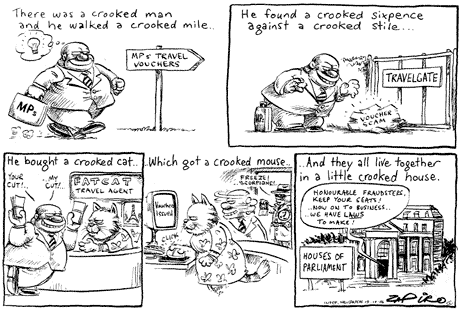
Wie sieht`s nun allgemein im Land zurzeit aus? An der Spitze der Polizei (glücklicherweise zumindest nicht mehr Interpols) steht immer noch der mit Mafia-Verbindungen gesegnete Selebi. Die Polizei insgesamt ist ebenfalls von Korruption durchsetzt. Travelgate, der Skandal über die Selbstbedienungsmetalität südafrikanischer Parlamentarier wird im Wesentlichen nicht gerichtlich geahndet. Armsgate, der Waffenbeschaffungsskandal, bei dem nicht sicher ist, ob Mbeki in die eigene Tasche oder die des ANC gewirtschaftet hat, wird wohl auch nicht vor Gericht entschieden werden. Zuma wird wohl auch vom Haken gelassen werden (http://www.int.iol.co.za/index.php?art_id=nw20080515175107327C849367), nur die Anti-Korruptionseinheit „Scorpions“ wird aufgelöst werden. Und Manto rettet die Nation noch immer mit Roter Bete.
Und dümmer geht es immer noch:
'Speed land reform to stop food crisis' Land and agrarian reform programmes must be accelerated to counter the looming food crisis, according to ANC secretary-general Gwede Mantashe.
Wenn man die Berichterstattung von AZ und Namibian der letzten Wochen verfolgt, so können einem da doch schon Zweifel kommen. Zur Einweihung des neuen Palastes hat Namibia nicht seine materiell herausragenden Unterstützer aus Europa eingeladen, sondern hochrangige Repräsentanten solch erfolgreicher Staaten wie Nordkorea, welches der Präsident seinen Studenten dann auch noch als nachzueiferndem Beispiel ans Herz gelegt hat.
Kaum gibt es eine Partei, die mit Aussicht auf Erfolg im SWAPO-Teich fischen könnte, zeigt diese ihr wahres Gesicht und lässt RDP-Versammlungen auflösen oder nicht zu und fordert ihre Mitglieder auf, „Verrätern“ keine Lebensmittel oder staatliche Aufträge zukommen zu lassen. Meines Wissens ist der Anzeigenboykott der Regierung gegen den Namibian wegen missliebiger Berichterstattung auch immer noch in Kraft.
Und dann gibt es da noch die SWAPO-Jugendliga (SPYL), die gegen die Marionette der Weißen in Zimbabwe (Tsvangirai) wettert. 18 Jahre nach der Unabhängigkeit eine Indoktrination solcher Art in der SWAPO sollte allen zu denken geben. Immer daran denken, Optimismus resultiert aus dem Mangel an Informationen 😉
'Food price anger will spark protests' Rising anger among the poor could result in widespread food protests unless the government acts to prevent the suffocation of lower- and middle-income groups through urgent measures such as zero-rating more food items, consumer bodies have warned.
Zimbabwe attacks 'out of control' The US ambassador said he had uncovered "firm evidence" of state-sponsored political bloodshed against supporters of Mr Tsvangirai's Movement for Democratic Change (MDC) in the aftermath of the elections on 29 March. He told the BBC's Newsnight programme: "Violence is spinning out of control. "Too many people have been killed, too many people have been maimed, too many people have been dislocated from their homes."
Violence spreads in Johannesburg At least 12 people have been killed in the South African city of Johannesburg since Friday in a wave of violence directed at immigrants, police say.
Violence in Johannesburg Spreading On the 7 p.m. South African Broadcasting Corporation news bulletin, violence hotspots were superimposed over a map of Johannesburg. Markers included Alexandra, Dieplsoot, Olifantsfontein, Tembisa, Thokoza, Jeppestown, Cleveland, Honeydew, Johannesburg Inner City, Sowetan and half a dozen other areas filled with rampaging mobs.
Mobs armed with petrol run amok Johannesburg - Mobs armed with knives, clubs and jugs of petrol were on Monday running amok in Johannesburg townships as xenophopbic attacks escalated.
Bishop: 'This is war' Johannesburg - This is war!" said Methodist church Bishop Paul Verryn, calling for a state of emergency to be declared and the army's help called in. Verryn's plea came on Sunday after gangs targeted immigrants at the church in continuing attacks fuelled by xenophobia. At least 13 people have died, two by the necklace method, in attacks which have raged in Johannesburg's city centre and across the East Rand and West Rand.
Immer daran denken, Optimismus resultiert aus dem Mangel an Informationen
Das kann nur vom Dauerpessimisten kommen
Ich hab` noch einen: Pessimisten sind Optimisten mit Erfahrung 😄
Im Ernst, zwischen 1993 und 1998-99 hätte ich nahezu alle Deine Äußerungen mitgezeichnet, insbesondere als ich mich über die negativen Ereignisse der Kolonialgeschichte und die Geschichte der Apartheid informiert hatte. Aber...
Gruß, Michael
SKskywalker200392 Beiträge · seit 200619. Mai 2008 ·
so leicht lasst Ihr Euch von einem Sammelsurium von Äpfeln in Nigeria, Birnen auf Mauritius, Johannisbeeren in Botswana, Karotten in Südafrika und, nicht zu vergessen, Mobiltelefonen auf dem Kontinent der Jungen ohne Jobs, die in Nordamerika ihren Beitrag zur Weltwirtschaft leisten werden, einfangen?
Ts, ts! 😉
Achtet einmal auf die wirtschaftliche Entwicklung Südafrikas in den nächsten 18 Monaten mit der Basis Mitte 2007.
Schon den heutigen Armutsbericht der Bundesregierung gelesen? Auch hier ist nicht alles Gold was glänzt - liegt auch immer im Auge des Betrachters 😉 Was haben hier die Meisten von ca. 2% Wachstum? Nominal eine Enteignung.
Was ich sagen will: glaube keiner Statistik - oder verstehe sie zu deuten...
Zum ersten Mal seit mehr als 15 Jahren hat es heute wieder ein Foto auf die Titelseite der Süddeutschen Zeitung geschafft, welches einen südafrikanischen Polizisten mit Gewehr vor rauchenden Trümmern mit Frau und Kind zeigt. Der Polizist ist nunmehr nicht mehr weiß sondern schwarz. Fürwahr ein signifikanter Fortschritt.
Da ist nun die Regenbogennation auf ihrer Wanderung über denselben auf der anderen Seite angekommen und, siehe da, es ist derselbe Schlammassel, aus dem sie einmal aufgebrochen sind. Und wieder kein Topf voll Gold!
Mob violence turns Jo'burg CBD into war zone Downtown Johannesburg is a wasteland this Sunday. Marshall Street is criss-crossed with makeshift barricades of rusty barbed wire, tyres and chunks of concrete. In Main Street, shops have been literally disembowelled, their heavy-duty Jozi iron shutters wrenched off and their interiors cleaned out, stripped of every Pringle jumper and pair of Converse sneakers.
A national disgrace As concern mounted over the xenophobic attacks in Gauteng that have left at least 22 people dead and up to 10 000 people seeking refuge in shelters, President Thabo Mbeki vowed that everything possible would be done to bring perpetrators to book.
'They can't stop us' "We will fight for this country. We will keep on going, they can't stop us," said the man, speaking to Sapa reporters through the bars of holding cell at the Reiger Park police station. The violence, which started in Alexandra, north of Johannesburg last week, spread to informal settlements on the perimeter of Johannesburg over the weekend, including Zamimpilo in Riverlea, Diepsloot and Kya Sands to the west of Johannesburg, and Ramaphosa and Makause in the east, as well as to Tembisa and Tokoza.
Hier noch eine Betrachtung der Vorfälle aus einem völlig anderen Blickwinkel:
Xenophobia caused by 'useless' locals
The interesting thing, though, was the number of building contractors – admittedly from smaller firms – who phoned the talk radio stations in the past week to express their views. I listened to at least six calls, maybe more, from contractors who said categorically "all the wet trades on buildings under construction are done by foreigners".
One particular caller claimed that most of the bricklaying, carpentry, plastering, tiling and, in some cases, even the plumbing was being done by foreigners. Not because these people will work for less money but because they're trained, skilled, eager and able to do the work. South African workers are not. Or at least not enough of them are skilled in these trades.