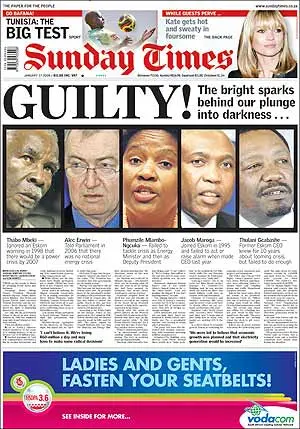
Und obwohl SASOL (Treibstoffgewinnung durch Kohleverflüssigung) auch Strom sparen muss, soll deren Produktion nicht sinken, obwohl auch Kohleminen ihren Betrieb einstellen mussten? Voodoonomics at it`s best? http://www.engineeringnews.co.za/article.php?a_id=125389 Logischerweise werden die Treibstoffpreise steigen müssen, da immer mehr Strom durch Generatoren erzeugt werden wird.
Womit will Südafrika denn die vielen Devisen verdienen, die es ihm ermöglichen würden, schnellstmöglich Kraftwerke zu bauen?
Norman of Fast Markets said that Eskom is struggling with aging infrastructure and coal shortages and the problems are likely to persist until 2013. There is no quick fix to these power problems and an effect on mine production is expected, Norman said.
Es wird aber wohl auch gar nichts nutzen, da die Blackouts es vielen, von Kolonialismus und Apartheid Gezeichneten, ermöglicht, Kabel zu stehlen und es als Altmetall zu verkaufen. http://www.int.iol.co.za/index.php?set_id=1&click_id=3053&art_id=vn20080127122513912C504120 Nach meiner Einschätzung wird der endgültige Zusammenbruch der Versorgungsinfrastruktur sich noch beschleunigen, da eine Polizei, die diesen Namen verdient dank AA in Südafrika ja auch nicht mehr existiert.
Carte Blanche ist ein politisches Magazin des Senders mnet. Die folgenden Aussagen entstammen einer Sendung über die aktuelle Energieversorgung:
Es kam ja alles so überraschend!
Derek: 'Warnings of a dark future were clear and accurate. A White Paper of 1998 said that the country would run out of electricity by 2007. Now, despite the dire prediction, it was never acted upon.' In 2004 the department of minerals and energy invited proposals to meet the need for approximately 1000mW required annually from 2007. But the private sector wasn't very interested, because Eskom wanted to retain at least 70 percent of generation and dominate the market. On Friday minister Alec Irvin admitted that had been a mistake.
Hier wurde natürlich nur der Wasserkopf abgebaut.
Jaco Kleynhans is Solidarity's spokesperson. He says the report was made public and given to Eskom. Jaco: 'We sent it to the government - at that stage, to Mr Alec Irwin. He knew about that. The statistics coming out of Eskom themselves said that they had seen the problem and that there was not enough people to do the work and not enough technical people to fix the problems. Those were the statistics that we gave to them two years ago. So it was on the table. It is not something new.' And in the past week Eskom finally admitted that it has a severe skills shortage, saying its workforce has dropped from 60 000 to less than half of that.
AA at it`s best!
Jaco: 'Eskom is probably one of the companies in the country driving affirmative action the hardest. You can drive the issue if you can get the people with the right skills and the right knowledge to do the work. Eskom didn't do that.' This letter from Eskom's HR department, dated 16 January this year, clearly spells out the policy stating: 'No white male appointments for the rest of the financial year.'
Die Ursache ist wohl nicht die Zunahme der Nachfrage, sondern die Abnahme der Produktion.
The current spate of blackouts started on Monday, 14 January and is still ongoing. The public has been told that it's due to a high consumer demand. Or is the truth actually that Eskom's power production has reached an all time low? This confidential report shows just that. On the 1 February last year - during the maintenance cycle - Eskom's output was more than 32 000mW. But this Thursday it spiralled to a debilitating low of 27 000mW. When you examine this page, the reason becomes obvious. All these units were out of service. The total capacity loss was over 9 000mW - enough to power three cities the size of Johannesburg.
Das Problem scheint eher der Mangel an Kohle bei den Kraftwerken zu sei (Südafrika hat Vorräte für mehrere hundert Jahre). Es ist ja auch nahezu unmöglich dafür zu sorgen, dass immer genügend Kohle dort vorhanden ist.
Bonita Nuttall (Carte Blanche presenter): Maybe the problem is not wet coal, but rather a lack of coal. Carte Blanche was tipped off by a contractor whose job at present is coal management at power stations. He said the story about wet coal is 'rubbish' and that coal supplies are in a chaotic state. On Thursday I joined Chris Badenhorst who has 20 years of experience in coal transport. Chris used to transport coal to the massive Tuthuka and Majuba power stations which, between them, generate 20 percent of the country's electricity. He says the stockpile of coal here at Majuba used to be 25 metres high until about four years ago. This is the storage site which was used to stockpile coal in the past. On Thursday this week it was visibly barren as we flew past it. There were only a few trucks offloading coal directly onto the conveyor belt leading to the furnaces.
Bei einem anderen Kraftwerk dasselbe:
Wouter Wolmerans used to deliver coal by truck to Majuba. Wouter Wolmerans (Transporter): 'There was always a lot of coal and a lot of trucks like 300 trucks standing there to offload coal. Tuthuka had a big stockpile - I would say about 400m long, 60m wide by 30m high.' When we flew past nearby Tuthuka power station there appeared to be no stockpile of coal. All that remains is a black stained stretch of land. However, Eskom's Steve Lennon insists that wet coal remains a major problem and, when pressed to supply Carte Blanche with figures of the actual stockpiles at the power stations, he declined. Derek: 'Can you give us a print-out of how much coal is being delivered to those stations?' Steve: 'We can give you the big picture on coal, but to give you the detail on every single power station and the coal situation is not our policy.' Derek: 'Why not?' Steve: 'Because there is obviously security issues that relate to the security of the supply to those power stations. But what I can say is that we have never been in the situation where our stockpiles have gotten to a zero or negative situation.' But where are those coal stocks?
Bis 2013 soll`s nicht besser werden, aber das hat natürlich keine Auswirkungen auf die Auslandsinvestitionen!
Derek: 'But what good are awards, Steve, when we have got no power? Surely, that is performance producing electricity?' Steve: 'Absolutely.' Derek: 'So why do they deserve R57-million?' Steve: 'It is our goal to continue to produce electricity.' That may be so, but will it be enough to steer this country away from free falling? After all, Eskom's Finance Director, Bongani Nqwababa, told Government last week to ward off investors - both foreign and local - until 2013 because of Eskom's inability to guarantee an adequate supply power. The Cape Town Chamber of Commerce and Industry was incensed by this comment.
So schafft man also Arbeitsplätze:
On Friday Eskom did the unthinkable. They requested South Africa's pride - our goldmines - to reduce their load to the minimum levels, effectively shutting them down. Reports quoted a loss to Harmony of R 60-million in one day. Close to half a million jobs in the mining sector are directly at risk.
Die Exporte gehen zwar weiter, aber maan kann sie ja anders nennen:
Derek: 'Steve, are we still delivering electricity to our neighbouring territories?' Steve: 'Yes, we are still delivering when we have electricity available. Most of our neighbouring countries are on what we have called 'unfirm' agreements. In other words, if we don't have it we don't deliver.' Derek: 'This week who did you supply to?' Steve: 'This week we would have supplied to most of our neighbouring states, Mozambique, Botswana...' Derek: 'This week?' Steve: 'When we are not load shedding, yes.' Derek: 'But your CEO said on Monday on SABC that you are no longer exporting to our neighbours.' Steve: 'No, the point is' Derek: 'He did say that!' Steve: 'The point is that we are not a net exporter of electricity. We import electricity mostly from Botswana and we export it to our neighbouring states.' Derek: 'But we helped set up most of those schemes so it is just a territorial import, if you know what I am saying.' This diagram from Eskom's intranet is for internal use only. It shows the megawatts that Eskom exports at a specific time to South Africa's neighbouring states. This week, while our gold mines were shut down, Eskom sent 761mW to the MOZAL aluminium smelter in Maputo. At the same time, Swaziland was receiving 476mW, Botswana 103mW, Namibia 126mW and Zimbabwe 51mW. Added up, this is more than 1 500mW six times the amount that Johannesburg was forced to load shed daily. We confirmed this information with the power utilities in two of our neighbouring countries.
Keine bösen Kolonialmächte sind die Ursache, keine rassistischen Weißen, keine diebischen Europäer. Es ist die schlichte Unfähigkeit, der zum Himmel schreiende Unwille, AA so lange zurück zu stellen, bis dazu fähige vormals Benachteiligte in der Lage sind, die Arbeit auch tatsächlich zu machen. Und dies gilt für alle Ebenen!
The soccer supremos now want two back-up generators at stadiums, because they have doubts about South Africa's electricity supply, as well as strongrooms at stadiums for VIPs - safety evacuation chambers where bigwigs such as presidents, ministers and other dignitaries could shelter in emergencies.
According to the report, the "estimated additional load" from the stadium and its surrounding development will stretch the already overloaded electricity network, making it impossible for the city to supply enough power.
hier ein Artikel aus Moneyweb zur Energiekrise. Da bei mir der Link nicht funktioniert, ausnahmesweise im Volltext:
It flashed out innocently on the wires on February 19, 2002: "Eskom, the world's leading buyer of coal, said yesterday that it might favour black-owned local producers over BHP Billiton and Anglo American, the two top mining companies, in future purchases. The state-owned monopoly power supplier might turn to black miners for all of the 30m tons a year of coal it might need to add by 2015, said chief executive Thulani Gcabashe".
By now, every South African who's not deaf, dumb and blind knows that Eskom's coal stockpiles at its coal fired stations are down to a day or two of supply, instead of the more prudential two months' worth. So-called "black economic empowerment" (BEE) is one of the two core reasons for Eskom's homemade Armageddon. Eskom's insane policy of chasing increasing procurement from blacks - regardless of the consequences - is at the heart of why South Africa now finds itself in a wheelchair with flat batteries.
The second core reason for Eskom's cataclysmic decline into festering swampland is its determination to enforce "affirmative action" (AA), regardless of the consequences. This is a more deadly force, given that the consequences of forcing "greybeards" out of Eskom to anywhere else, preferably the streets, has translated into fatal mistakes in maintenance.
Eskom owns high technology power stations, utilizing First World boilers, steam turbines, generators and rocket-science shafts. As the years have piled up since 1994, so Eskom's maintenance has increasingly decomposed. To now name BEE and AA as the core reasons for Eskom's meltdown may be the most politically incorrect thing in the world, but it's written right across the skies. Government and Eskom have not once mentioned BEE or AA among the vile plethora of reasons for crippling failures over the past few weeks.
Typical spin goes like this: "during the week of 14 January 2008, there were over 5,000 MW of power plant not available due to unplanned outages. Some of the reasons for these failures were: Boiler tube leaks/failure; various smaller equipment failure; generator output reductions (load losses) as a result of coal quality, and problems with coal supply". Rather than negotiating increased coal feed with the likes of BHP Billiton and Anglo American, the public are told that "it is crucial that Eskom working with the DME [Department of Minerals and Energy] begin acquiring higher quality coal that will enable generators to run at full capacity".
The DME does not supply coal. Instead, it has powers to whip, bludgeon and abuse private sector coal diggers like BHP Billiton and Anglo American. The bedfellows are well matched: the arrogance of the DME's ruling cabal equals the arrogance and insolence of Eskom's executives. Gcabashe went so far in 2002 to state that "options now included reserving a quota of coal purchases for black-owned companies".
To the trained eye, the spin from Eskom and government cannot disguise the systemic wreckage that BEE and AA have drenched over South Africa's power stations and electrical distribution system. The country's once world-class power stations are being frog marched toward the filthy graveyards of Africa's atavistic heritage.
Economic crime on this unimaginable scale can be most readily compared to the indescribably huge carcasses of once-world class copper mines in southern Katanga Province, Democratic Republic of the Congo. On 31 December 1966, the Congolese government, led by erstwhile dictator Joseph-Désiré Mobutu, seized the keys of Union Minière du Haut Katanga, a Belgian trust founded in 1906.
The new entity, state-owned Gécamines (La Générale des Carrières et des Mines) malevolently inherited one of the world's richest contiguous copper, cobalt and zinc fields. But a good number of skilled professionals remained on site, and as recently as the late 1980s, each year, Gécamines was producing nearly 500,000 tons of copper, 60,000 tons of zinc, and 14,000 tons of cobalt.
Mobutu renamed himself Mobutu Sese Seko Kuku Ngbendu Wa Za Banga ("The all-powerful warrior who, because of his endurance and inflexible will to win, goes from conquest to conquest, leaving fire in his wake"), and launched raid after raid on the cash at Gécamines.
This finally culminated in his downfall as president, and the virtual destruction of Gécamines, which had always demanded substantial maintenance and expansion capital expenditure to remain in business. In recent years, Gécamines has produced less than 10,000 tons of copper a year, and less than 1,000 tons each of zinc and cobalt. Massive tonnages of virgin copper, zinc and cobalt remains to be dug out. Rehabilitation in Katanga Province has recently started, funded by investment from the West, and likely also from China.
Allerdings bezieht sich der Zusammenbruch der Versorgungsinfrastruktur nicht nur auf die Elektrizität, sondern auch auf Trinkwasser:
Free State DA leader Roy Jankielsohn said it seemed the provincial government and the municipalities were unable to provide or oversee the water supply or quality of drinking water in the province.
Es ist ja auch wirklich schwierig, rechtzeitig Wartungs- und Reparaturmaßnahmen einzuleiten:
The eThekwini municipality has been singled out as one of the "most significant" polluters of some rivers because of the failure to repair burst sewer lines and poor management at some waste-water treatment plants.
glücklicherweise besitzt Südafrika anerkanntermaßen ja mehr als genug Wasser:
South Africa is on the brink of a water contamination crisis, potentially as bad as the electricity fiasco of the past few weeks, Business Times reported on Sunday. In an alarming report, the National Nuclear Regulator (NNR) has confirmed evidence of contaminated crops and water, and has acted to protect people and livestock, the newspaper said. The report - in the possession of the newspaper - is the latest of several recent indicators that government is no longer able to effectively monitor and manage its vast infrastructure of dams, pipes, pumps and treatment facilities.
Es wundert allerdings überhaupt nicht, wenn man weiß, dass aus ideologischen Gründen erfahrene Weiße gefeuert und nicht qualifizierte Schwarze geheuert werden. Wenn man nun davon ausgeht, dass wenigstens für die Zukunft seitens der südafrikanischen Regierung dafür gesorgt wird, dass qualifizierte Schwarze nachwachsen können, so sieht man sich –wie eigentlich immer- getäuscht:
It seems the entire economic structure which underpinned apartheid is essentially unchanged. Oppression based on race has morphed seamlessly into oppression based on economic circumstance. The faces at the top have changed from white to black but the substance of change is an illusion.
Common Sense 101, multiple choice examination question 1. You are a political party that has just come to power in a country’s first democratic election. The previous government only provided utilities for around 7 million people out of a population of around 43 million. The supply of water and electricity to everyone is one of your core manifesto promises. Will you require a) more power stations b) fewer power stations c) don’t know Dd a kickback to get me interested? A fairly simple question and in case you’re still puzzling over the answer, it is a. The answer the knuckleheads at the ANC gave was b, which is why we are looking increasingly like Zimbabwe at the moment.
Und hier die Transvaal Agricultural Union, die Standesvertretung derer, die einer der größten Nutznießer der Apartheid waren, nämlich die südafrikanischen Farmer. Aber, auch wenn sie nicht pc sind, machen sie doch ein paar Punkte deutlich, die dem durchschnittlichen europäischen Gutmenschen zu denken geben sollte, denn Subsistenz-Landwirtschaft zerstört die Böden, füttert weniger Leute, bringt keine Steuern und führt damit mittelfristig zu Hunger, wie im überwiegenden Rest des Kontinents.
The past few weeks of daily power failures and blackouts in South Africa have indeed become the SA government's Waterloo, or to use a popular South African political term, its Rubicon. This catastrophe elicited the attention of the world's news media which termed it a power "emergency". Eskom, South Africa's power monopoly, fumbled and failed, and the consequences were devastating.
Electricity is the great equalizer. It's either here or it's not. Obfuscation, referring matters to committees, stating the problem is sub-judice or simply ignoring phone enquiries may have worked until now with other problems besetting the country, but these excuses can no longer be used to fob off a now-enraged South African public. The TV actuality show Carte Blanche's coverage of the fiasco elicited far more response than any other program in the network's recent history as hundreds of thousands of viewers registered their disgust and anger. Other websites set up by concerned groups received thousands of hits within hours.
There isn't anyone who was not affected by the calamitous electricity blackouts that temporarily closed down the country's mining industry which was stricken with losses of R193 million a day. On January 28, some mines had entered their fourth day without enough electricity to work underground.
SURPRISING
It is surprising that many are surprised at the latest South African debacle - electricity "load shedding", a euphemism for blackouts. This latest shambles is surely part of a trend so obvious over the past few years as infrastructure crumbled, productive farms became squatter camps, lavish salaries ate into budgets (Eskom's top brass has been paid a total of R157 million over the past three years), and municipalities became the black sheep of governmental structures in South Africa.
Perhaps it is time to cease dancing around the crux of the problem - forward planning and preventative maintenance are Western concepts and have never been generic to Africa. But subsistence thinking and practice are: Martin Meredith's recent book The State of Africa - A History of Fifty Years of Independence reveals in depressing clarity that "no other area of the world arouses such a sense of foreboding, and few states have managed to escape the downward spiral".
The ills of South Africa's power provider are mirror images of what has happened in sub-Saharan Africa since the end of colonialism. Not only has little emerged to show that the populations built on that legacy, but that what remained after the European powers left has fallen into disrepair and decay. This is evidence not only of a subsistence mentality, but in some cases a destructive one. This mindset does not plan ahead, and does not maintain. One can see this now in South Africa - the decay, the peeling paint, the broken pipes, the government buildings going to seed, our Defence Force structures plundered, our roads, hospitals and schools deteriorating, our farmland eroding, our cities sliding into slums and crime nests. Why would Eskom escape the trend?
Dictionaries define "maintain" inter alia as "keeping unimpaired or in proper condition". This means fixing before it breaks, not afterwards. Thus, to maintain means to look ahead, to foresee problems rather than have to confront them when they arrive. Generally, South Africa's African languages do not embrace a concept of maintenance - a Zulu dictionary defines "to maintain" as keeping a standard, or the government must maintain the roads. This implies that someone else must maintain. In Venda and Tswana, for example, the concept of maintenance is foreign. There are words to repair things, but this only after something is broken.
Machinery, industrial and electronic equipment necessary to keep up with an industrial age are symptoms of colonial and settler cultures. Industry never evolved in Africa, it was not a generic development, it was brought to Africa by people of other continents. Thus, to maintain, to plan forward, to understand maths and physics and to possess the engineering skills needed to keep a modern first world system functioning are not generic to Africa. If they were, Africa would have evolved along with everyone else.
FARMS
This is the basis of the tragedy surrounding the handover of South Africa's productive farms to third world people to whom commercial farming, with its complicated functions and sophisticated methods, is in many respects a foreign concept. Former productive farms are still collapsing, despite empirical evidence that the government's land "reform" process is an abject failure. A recent Business Day report makes distressing but predictable reading:
"If all white farmers' fears, resentment and prophecies of doom about land reform by SA's black majority government could be reduced to the fate of one district, it would be that which befell Trichardtsdal in the Limpopo lowveld. Here in this tropical fruit farming community lie the ruins of what once held the hopes and dreams of those aiming to subject the anarchic Bushveld to modernity and agricultural enterprise. On now deserted farms transferred to land claims beneficiaries between five and two years ago, we found scene after scene of destruction. These were not farms where production had simply been halted as a consequence of land claims and where neglect had taken its toll - these farms had been destroyed beyond redemption. They are now perhaps fit only to be returned to the era before the eradication of malaria and the tsetse opened up the lowveld to agriculture on a scale and productivity unmatched anywhere in the country".
The report talks not only of decline but vandalism, destruction, theft and decay. It is a shocking report, but not shocking to those who know what happens when some third world components of South Africa are allowed to take control of the country's first world assets. Warnings by commercial agriculture over the years have fallen on deaf ears - the country seemed to believe that the availability of cheap and beautiful fresh produce seen daily in our supermarkets would go on forever.
But Eskom's power failure has put an end to that. Now South Africa is looking at why the lights went out, and is demanding that those qualified people who were cast aside when the new government took over be brought back to salvage what is salvageable, before our country's infrastructure indeed sinks into what the Business Day journalists call a situation "beyond redemption". (Much of the press which so unctuously punted the coming to power of the current government is now infuriated at the current state of affairs.)
Martin Meredith's book confirms the above trend. In country after country, the pattern was the same. Euphoria with independence, the world's cognoscenti applauding the new freedom, soon followed by the centralization of power, subversion of the judiciary, corruption, plundering of state assets, the collapse of infrastructure, the foreign aid, then wars over the shrinking economic cake.
It was all so predictable, and what has happened to Eskom bears all the hallmarks of this trend - the huge self-awarded salaries, the total lack of shame at taking those salaries while the system collapsed, the blithe neglect of forward planning and timely warnings, and the blatant lack of accountability to taxpayers who pay the salaries of the new elite, many of whom believe South Africa and its assets are theirs for the taking. The trends in Africa so visibly and grotesquely detailed by Meredith are now becoming part and parcel of South Africa.
It's time to take back the function of keeping South Africa on the rails. Otherwise we will indeed be "beyond redemption".
WO LEBT DENN DIESE FRAU??? Ich bin sprachlos, liest die nicht mal suedafrikanische Zeitungen, die das Gegenteil berichten und beweisen? Ich koennte ihren Artikel in so vielen Punkten auseinandernehmen, dass davon nicht viel uebrig bliebe. Schade um die Zeit. In Berlin ist sie zu weit von den Realitaeten weg, und wer weiss, wer sie dafuer bezahlt. Helmar (Durban)
ich möchte heute einmal auf einen weiteren möglichen Krisenherd in Südafrika hinweisen, nämlich dem Antagonismus zwischen Zulu und Xhosa, die durch die unterschiedliche Machtverteilung, die über den Zugang zu Finanzmitteln entscheidet, seit 1994 befeuert wird.
Zu Apartheidszeiten wurde der historisch gewachsene Antagonismus von den Regierungen im Sinne von „teile und herrsche“ zur Festigung ihrer Position benutzt. Vor der ersten allgemeinen und freine Wahl führte dies zu bürgerkriegsähnlichen Zuständen in vielen Teilen des Landes:
140 BLACKS SLAIN IN SOUTH AFRICA AS FACTIONS CLASH
An der Ostküste nun versucht die Regierung, gegen eine, im Vergleich zum potentiellen Wert des Landes, sehr geringe Entschädigung, Zugriff auf Land zu erhalten, welches riesige Vorkommen von Mineralsändern (u.a. Titan) birgt:
In a statement, DA health spokesperson Mike Waters claimed that a KwaZulu-Natal doctor was charged with misconduct for dispensing dual therapy treatment to HIV-positive babies.
Elektrizitätsversorgung: Irgendwie haben wir es ja schon geahnt! 14 Jahre nach dem Beginn der Majority Rule, nach AA und BEE müssen natürlich die Apartheid-Regierungen Schuld sein! Wenn es nicht so unglaublich dreist und dumm wäre, könnte man ja schon fast wieder drüber lachen. „A better life for all“ versprach der ANC! Leute, wie dieser Kommentator sorgen dafür, dass die Blaupause auch umgesetzt wird.
Paul Gaydon is a human waste expert who has studied sewage systems all over Africa. He showed us a 2006 report commissioned by the department of water affairs and forestry, or DWAF, on the state of sewage plants nationally. The results should have sounded alarm bells. Almost one third of South Africa's 1 000 water treatment plants require immediate intervention to avoid a crisis.
YOUR STORY This is Africa, isn't it? 07/02/2008 14:31 - (SA)
Sello Molekwa, News24 User
I am worried about the political state of most African countries. There has been war in Sierra Leone, DRC, Angola, Ethiopia, Rwanda, Liberia, Sudan and now fighting in Kenya and Chad. All the wars in these countries claimed thousands of innocent lives, but what is even more painful is that these wars were highly avoidable.
Why are most African governments incapable of running a simple election without bloodshed? Throughout the entire continent, communities are so disorganised, roads are not tarred, our education systems have literally collapsed and we still have children attending schools under trees in this age.
Our public health systems are terrible and thousands of African people die of highly preventable and curable diseases. There's unemployment and people still die of hunger of all things!
Health care and Education are the most basic needs of every society and every government that fails to provide these two, does not deserve to govern any further
Visible failures
Yet here in Africa political parties continue to run governments for decades despite their visible failure to provide people with simple proper health care. While this bad state of affairs is going on, politicians are busy fighting for power at the top, war rebels continue to fight and kill innocent civilians while at it. Africans are always on the run from their own governments.
We are a continent that is rich in minerals and natural resources but yet the poorest in the world. Our situation is so pathetic that European and US governments are forced to do something about Africa because we can't help ourselves. We are everyone's problem. And to make matters worse, our African presidents will not admit that they are failing, they are very arrogant, proud and stubborn people!
Most African states have failed to make a success of their independence. Our black governments are failing and I know fellow blacks would kill me for saying this, but that's the problem, we become defensive and furious instead of looking at reality in order to find solutions.
Our economies have collapsed. Let's be honest to ourselves and admit that our black leaders throughout the continent have so far dismally failed in governing their countries.
The answer is entrepreneurship
Our leaders seem too stupid to figure out that the only way to resuscitate this continent's economy is to design and implement new and progressive education syllabuses that will empower our children with mental power and innovation skills in order to produce innovators, inventors, designers and producers. This is called entrepreneurship!
Once we do this, we will be able to build our own companies and enter international markets, our people will be employed and the continent will start generating its own wealth.
Here in South Africa black people depend on government jobs, grants and tenders for survival, but this is a dangerous culture and it will come back to haunt us! The number of unemployed matrics is increasing annually and one day our government will suddenly realise we are in big trouble and urgently need companies to employ these youths.
But who must build those companies? White people have already done enough to build our economy and provide jobs; it's our turn now, but here we are, fumbling around! Blaming apartheid and using BEE to force our way into white companies won't help either.
We are only fooling ourselves and creating a bad lazy culture for our children.
The people inquiring about quitting South Africa were "split across the race spectrum", and many of them were highly qualified professionals who had a potential to start a new life in another country with ease, according to Eden Joubert, a lawyer with Emigration group.
The lights are literally and figuratively going out all over South Africa as crime, corruption and mismanagement push the rainbow country towards becoming another failed african state.
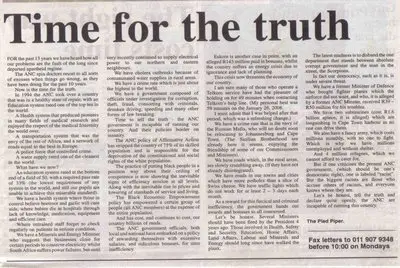
Ein Leserbrief. Leider habe ich die Zeitung nicht herausfinden können. Den Scan habe ich am Ende eingefügt.
TIME FOR THE TRUTH
For the past 13 years we have heard how all our problems are the fault of the long since departed apartheid regime.
The ANC spin doctors resort to all sorts of excuses when things go wrong, as they have been doing for the past 10 years.
Now is the time for the truth.
In 1994 the ANC took over a country that was in a healthy state of repair, with an Education system rated one of the top ten in the world.
A Health system that produced pioneers in many fields of medical research and enjoyed the respect of the medical fraternity the world over.
A transportation system that was the envy of the rest of Africa, and a network of roads equal to the best in Europe.
A police force that controlled crime.
A water supply rated one of the cleanest in the world.
What have we now?
An education system rated at the bottom end of a field of 50, with a required pass rate of 33% (the lowest requirement of any system in the world, and still our pupils are unable to achieve this miserable standard).
We have a health system where those in control believe beetroot and garlic will cure AIDS, where babies die in hospitals through lack of knowledge, medication, equipment and efficient care.
Where untrained staff forget to check regularly on patients in serious condition.
We have a Minerals and Energy Minister who suggests that businesses close for certain periods to conserve electricity whilst South Arica suffers power failures, but until very recently continued to supply electrical power to our northern and eastern neighbours.
We have cholera outbreaks because of contaminated water supplies in rural areas.
We have a crime rate which is just about the highest in the world.
We have a government composed of officials under investigation for corruption, theft, fraud, consorting with criminals, drunken driving, speeding and many other forms of law breaking.
Time to tell the truth – the ANC government is incapable of running our country. And their policies border on insanity.
The ANC policy of Affirmative Action has stripped the country of 75% of its skilled population and is responsible for the deprivation of the constitutional and social rights of the white population.
The practice of putting black people in a position way above their ceiling of competence is now showing the inevitable signs of efficiency erosion at all levels. Along with the inevitable rise in prices and lowering of standards of service and living.
The Black Economic Empowerment policy has empowered a certain group of people (all ANC members) at the expense of the entire population. And has cost, and continues to cost, our country billions of rand.
The ANC government officials, both local and national have embarked on a policy of rewarding themselves with excessive salaries, and ridiculous bonuses, for utter inefficiency.
Eskom is another case in point, with an alleged R143 million paid in bonuses, whilst the country suffers an energy crisis due to ignorance and lack of planning. This crisis now threatens the economy of our country.
I am sure many of those who operate a Telkom service have had the pleasure of holding on for 49 minutes when contacting Telkom's help line. (My personal best was 59 minutes on January 26, 2008. I must admit that I was helped after that period, which was a refreshing change).
We have a crime rate that is the envy of the Russian Mafia, who will no doubt soon be relocating to Johannesburg and Cape Town. (The Sicilian Brotherhood are already here it seems, enjoying the friendship of some of our Commissioners and Ministers).
We have roads which, in the rural areas, are slowly crumbling away, if they have not already disintegrated.
We have roads in our towns and cities which have more potholes than a slice of Swiss cheese. We have traffic lights which do not work for at least 2 - 3 days each month.
As a reward for this farcical and criminal inefficiency, the government hands out awards and bonuses to all concerned.
Let's be honest. Several Ministers should have been fired by the President 4 years ago. Those involved in Health, Safety and Security, Education, Home Affairs, Land Affairs, Labour and Minerals and Energy should long since have walked the plank.
The latest madness is to disband the one department that stands between absolute corrupt government and the man in the street, the Scorpions.
In fact our democracy, such as it is, is under severe threat.
We have a former Minister of Defence who bought fighter planes which the airforce did not want, and who, it is alleged by a former ANC Minister, received R39-R50 million for his troubles.
We have two submarines (cost R1.6 billion a piece, it is alleged) which are languishing in Cape Town Harbour as no one can drive them.
We also have a fancy army, which costs millions monthly, with no one to fight. Which is why we have millions unemployed and without shelter.
And 4 million refugees, which we cannot afford to cater for.
But if one criticises the present ANC government, (which should be one’s democratic right), one is labeled 'racist'. But the biggest racists are those who accuse others of racism, and everyone knows where they are.
Let's be honest, tell the truth and declare quite openly, the ANC are incapable of running this country.
The Pied Piper.
Müsste, könnte, würde – die Variationen des Konjunktivs beschreiben das Schicksal eines Kontinents und seiner 800 Millionen Menschen. Statt seinen Wohlstand zu mehren, ist Afrika weit hinter den Rest der Welt zurückgefallen. Trotz einzelner Fortschritte besteht sein Antlitz noch immer aus extremer Armut, Krankheit und Gewalt: Die blutigen Kämpfe, die Kenia seit der Wahlfarce Ende Dezember erschüttern, sind ein neuerlicher Beleg dafür, wie labil selbst die vermeintlichen Stabilitätsanker des schwarzen Kontinents sind.
Ich habe in diesem Thread vor ein paar Wochen den Zusammenbruch Südafrikas prognostiziert. Ich habe dafür den Zeitraum gewählt, den schwarzafrikanische Staaten bisher maximal hatten, bevor ihre eigenen Eliten sie in Grund und Boden gewirtschaftet hatten, nämlich 25 Jahre. Ulli antwortete daraufhin mit –wie ich vermute- feinem Spott, dass die Maya eine Weltuntergangsprophezeihung für 2012 abgegeben hatten. Ja, Ulli, ich glaube, ich hatte Unrecht!
Der Zusammenbruch wird wahrscheinlich früher eintreten. Ob schon bis 2012, bleibt abzuwarten. Die Währung ist in der Regel ein guter Indikator und der NAM$ an den Rand gekoppelt. Irgendjemand jubelte hier doch schon vor kurzem, dass die Entwicklung des Wechselkurses die Preissteigerungen mittlerweile wettmacht. Schauen wir uns also die wirtschaftliche Entwicklung Südafrikas in diesem Jahr genau an.
Und immer daran denken: Schwarzafrikanische Demokratie bedeutet in der Regel „One man, one vote, once!“
ich kann es mir einfach nicht verkneifen immer wieder aufs neue zu Antworten und muss mich dafür entschuldigen. Aber solche Kommentare wie in dem Leserbrief zu Anfang sind doch absoluter Schwachsinn. Nicht dass ich den ANC gut heiße und vor Allem nicht (ausahmslos) dessen Politik.
Es muss aber deutlich gemacht werden - und genau das will ich um Michael keine unkommentierte Plattform zu bieten:
Die Arbeit der Polizei in den 90ern war selektiv. Die Verhaftungen auch. Die gerechte Behandlung der Festgenommen auch.
Die beste Bildung war selektiv. Die Farbe der Gebildeten auch.
Das beste Trinkwasser war es genauso.
Das Gesundheitssystem war auch nicht für Jeden da. Und da es nun ein paar Millionen Menschen mehr zu versorgen gibt und verschiedene Homelands in die Statistik hinzukommen, kein Wunder.
Ich empfehle jedem ausdrücklich das Jahre alte Buch APARTHEID von Günther Verheugen (ja DEM Verheugen). Es liest sich wie ein Kriminalroman und ist von besonderem Interesse, weil es die Deutschen Interessen am Kap miteinbezieht. Verheugen deckte Mißstände in Südafrika auf, aber vor Allem auch in der deutschen Politik, Wirtschaft, den Verbänden und der Gesellschaft. Alle verkannten die Brisanz und Wahrheit der Apartheid und die Abartigkeit und Unmenschlichkeit des ausführenden Regimes. Yoshikawa und seine Leserbriefautoren tun das auch.
es lebe die Apokalypse. Kann es sein, dass in Deinem Familienstammbaum auch ein gewisser Nostradamus auftaucht 😉
Jetzt aber im Ernst und in Kürze: die Wechselkursentwicklung als Indikator für den Untergang eines Landes zu nehmen ist ein verlockender Trugschluss. Hier aber nur zwei Gegenbeispiele: von der Hyperinflation in der Weimarer Republik bis zum Untergang des Deutschen Reiches hat es immerhin zweiundzwanzig Jahre bedurft (was aber andere Gründe hatte), der USD ist in den letzten fünf Jahren gar noch stärker gefallen als der ZAR. Ich sehe die Staatsführer Mbeki und Bush schon gemeinsam am Abgrund stehen - man kann sich nur nicht entscheiden, ob bei God´s Window oder im Grand Canyon.
Nutze Deine hellseherischen Fähigkeiten doch für kontruktivere Dinge wie Vorhersage der Lottozahlen. Und wenn Du Wetten auf Deine Prognosen abschließen willst, versuche es mal mit Sportwetten.
Warum ich mal wieder schreibe: ich sehe bei Dir einen Rückfall in alte Muster. Deine Rechthaberei erinnert mich stark an ein pubertierendes starrsinniges Kind. Du willst aber Doch ernst genommen werden. Deine Person - mit bedrohlichen Postings assoziiert - hat immerhin für einen großen Lacher auf dem Winter - Potjie gesorgt. Das ist vermutlich nicht die Reaktion, die Du Dir wünscht - Anerkennung sieht anders aus. So "wahr" auch etliche Deiner Postings sein mögen - überspanne nicht den Bogen, der Schuss wird nach hinten losgehen...
warum siehst Du Dich denn eigentlich genötigt, Dich zu äußern? Wenn ich mich in den öffentlichen Raum begebe und Einschätzungen abgebe, dann ist mir bewusst, dass es nicht nur Menschen gibt, die meine Einschätzungen teilen. Wenn ich bei Menschen, die mich nicht persönlich kennen, für Heiterkeit sorge: So what? Die Freude sei ihnen gegönnt! Lottozahlen kann ich natürlich weder vorhersagen noch in der Tendenz bestimmen, weil es sich dort um Zufall handelt. Die negative Entwicklung Südafrikas ist jedoch kein Zufall!
Ich weise wieder einmal auf den Umstand hin, dass von Afrika-Optimisten, insbesondere Südafrika-Optimisten, zu denen Du gehörst, seit dem Start dieses Threads im Wesentlichen nur Empfindungen und Einschätzungen geäußert wurden, ohne dass diese zumindest mit Indizien hinterlegt wurden. Auch Deine jetzige Wortmeldung hebt nur auf mein von Dir bewertetes Verhalten und die mir unterstellte Motivation ab, nicht auf die von mir geschilderten Tatsachen. Solange Du/Ihr nichts Besseres habt, nehme ich halt in Kauf, für Dich/Euch ein Trotzkopf zu sein.
Du pfeifst im dunklen Wald, Volker, da für Dich nicht sein kann, was nicht sein darf. Hast Du Zimbabwe schon vergessen?
Rapport newspaper notes in a front-page story on February 3 2008 that foreign investors have been dumping their shares on the Johannesburg Stock Exchange to the tune of R5-billion last week alone. And bonds are also being offloaded by foreign investors at a massive rate -- thus far R12,25-billion were sold by foreign investors over the past twelve months. Foreign investors are clearly rapidly losing faith in the long-term growth possibilities of the South African economy due to the growing electricity crisis. Dr. Elna Moolman, economist at BJM, said the biggest effect of SA's power shortages will be this loss of trust from foreign investors. "If the electricity shortages are seen to be substantial and long-lasting, it can have a very real influence on future growth. "This will discourage foreign investments and thus can also have a very negative effect on the Rand's exchange rate.' David Galloway, strategist and senior portfolio-manager at SMMI, said the outflow of foreign investment funds due to the power-crisis was also seen in the massive dumping of bonds. In December alone, R5,8-billion in bonds were sold by foreign investors -- and thus far these past twelve months, a whopping R12,25-billion has left South Africa as foreign investors were withdrawing their investments from the country.
was soll ich mit Jemandem diskutieren, der die Weißheit für sich gepachtet hat? Wer mich kennt, weiß sehr wohl, dass ich keine rosarote Brille trage und viele Entwicklungen durchaus kritisch sehe. Aber was/wem hilft es, wenn ich dann noch ständig mit dem Knüppel drauf haue? Wer sein Kind liebt, versucht ihm zu helfen. Vielleicht befinde ich mich im dunklen Wald und überlege, ein paar Bäume zu schlagen, damit es wieder heller wird, während Ich Dich eher im Blindstollen sehe.
Noch eine Frage: möchstest Du als Mensch nach dem beurteilt werden, wofür die politische/wirtschaftliche Führung in Deinem Land steht??? Aber Dir geht es vermutlich nicht um die Menschen. Ihnen geht es genauso wie Dir und mir: sie möchten respektiert werden und dazu gehört Toleranz und Akzeptanz des Anderen, man braucht sich nur mit Ihnen zu unterhalten.
Sonnige Grüße aus dem Hochhauswald in Frankfurt,
Volker
Bye bye Forum
WolffRuediger1’125 Beiträge · seit 200611. Feb. 2008 ·
Hallo zusammen, ich begebe mich mal ins Haifischbecken. Michael und Volker, Ihr habt Euch verbissen, kehrt zurück. - Ich selber liebe SA und Namibia, seit 22 Jahren bin ich jedes Jahr dort. Meine Schwester lebt seit 25 Jahren in einer südafrikanischen - kleineren - Universitätsstadt. Ich kenne viele Leute dort - aller Hautfarben. Es ist keine Prophetie von Apokalypse, wenn man den allmählichen Niedergang, in manchen Sektoren auch Zusammenbruch, von Strukturen feststellt. Dass in der Apartheidszeit das gesamte System von Grund auf menschenverachtend war, steht außer Zweifel - niemand von uns stellt es in Zweifel (und darüber sollten wir uns auch nie streiten!). Aber es wurde der Nachfolgeregierung eine Infrastruktur hinterlassen, die so nicht mehr existiert. Und es gibt Ursachen, Michael hat sie dargestellt - es IST einfach so, bei aller Sympathie, ja Liebe. Was ich selbst gesehen und von meiner Schwester erzählt bekommen habe, lässt finstere Befürchtungen zu. Wenn in einer Woche dreimal jeweils siebeneinhalb Stunden der Strom abgestellt wird, weil Eskom nicht in der Lage ist, Strom zu liefern - ist das nur ein Punkt. Die Ursachen sind bekannt und zur Genüge dargestellt. Mein angeheirateter Neffe, wohnhaft in JNB, leitender Angestellter bei Eskom, kein Weißer, schlägt sich die Hände über den Kopf zusammen, wenn er mir erzählt, welche Leute ohne Qualifikation auf Chefposten gekommen sind, nur weil sie schwarz sind. Es ist einfach so, verdammt nochmal. - Noch ein (verallgemeinerbares) Beispiel: Meine Schwester hat sich vor wenigen Jahren für einen Abteilungsleiterposten an ihrer Universität (Verwaltung) beworben. Gleichzeitig bewarb sich eine Putzfrau, Analphabetin, für denselben Posten - mit der Begründung, sie sei eine schwarze Frau. Sie hätte den Posten fast bekommen! Nochmals meine Schwester. Die Frau arbeitet sich halbtot, weil ihr Büro tagaus, tagein eingerannt wird von schwarzen jungen Frauen aus der Verwaltung - mit der Bitte, dies oder jenes für sie zu tun, weil sie das nicht könnten - aber eben dafür sind sie eingestellt worden!!! Die eine kann kein Protokoll schreiben, obwohl es ihre Aufgabe wäre, die andere kann keinen Formbrief aufsetzen - und so geht das weiter. Ich könnte stundenlang darüber schreiben ... Fazit: Michael kann man (vielleicht) dies oder jenes vorwerfen, aber eines nicht: Naiv ist er nicht. Aber wir wollen vieles nicht hören. Lasst ihn, er ist ein gutes Korrektiv zu dem, was wir eigentlich gerne hören und lesen möchten, weil wir wollen, dass eine geliebte Welt so ist, wie wir sie uns wünschen. Bitte entschuldigt den Wortreichtum. Wolff-Rüdiger
ich gebe Dir in vielen Punkten Recht, habe von Bekannten in SA ähnliche Erfahrungen berichtet bekommen.
Du hast die "Diskussion" zwischen Michael und mir vermutlich nicht komplett mitverfolgt. Ich werfe ihm in keinster Weise Naivität vor, das schlägt mir eher von seiner Seite entgegen. Was mich stört, ist die absolut einseitige und trommelgewehrmäßige "Berichterstattung". Außerdem: was soll das, sich auf das "Untergangsdatum" Südafrikas - wie immer das auch definiert sein mag, Yoshi, hilf mir - festlegen zu wollen? Das erweckt in mir - und nicht nur in mir - das Gefühl von Schadenfreude und Zynismus, genau das stört mich - nicht mehr und nicht weniger.
Viele Grüße,
Volker
PS: Ich bin für eine Diskussion jederzeit zu haben, aber dieses Reiseforum ist dafür nicht die geeignete Plattform. Just my two cents...
Bye bye Forum
Thema geschlossen
Dieses Thema ist geschlossen — neue Antworten sind nicht möglich.