GinaChris4'984 Beiträge · seit 201611. Mai 2019 · #2
Informanté
7 Std. ·
Four more Congo Fever cases reported
Zorena Jantze
AN elderly man is dead and four more people have been isolated in different hospitals as a result of an outbreak of Congo Fever in Namibia.
The four new cases have been admitted to hospitals for treatment and observation purposes in different regions across the country.
Selma Robert, National Surveillance Officer on the spread of Disease in the Ministry of Health confirmed that a 77-year-old man died as a result of the viral infection on Tuesday, 7 May.
Robert said the diseased elderly man was the neighbour of the first confirmed Congo Fever case patient, a 54-year-old female from Ontananga Village who visited the health facility with complaints of tick-bite, headache, body weakness and blood-stained vomit on 26 April. She added that the 54-year-old female is still alive and is under medical treatment and tight observation.
According to Robert of the four new incidents of possible infection, two patients were admitted and isolated in the Oshikoto region, one in Outapi, and one person in Windhoek.
Robert added that Congo Fever has been a seasonal occurrence in Namibia with outbreaks in different towns reported in places such as Gobabis last year, Keetmanshoop, and the Omusati Region in previous years.
She stated that infected Ticks are almost everywhere in the country and that the situation is worsened by the drought as human to animal contact has increased due to the deteriorating health of livestock.
She advised members of the public to wear bright clothing in high risk areas in order to easily notice if they have ticks on them and to wear protective clothing and gloves when handling animals.
Crimean-Congo Haemorrhagic Fever is a viral disease transmitted by ticks. It can be responsible for severe outbreaks and death in humans.
Symptoms of Congo fever include muscle ache, dizziness, neck pain and stiffness, backache, headache, sore eyes and photophobia (sensitivity to light). There may also be nausea, vomiting, diarrhoea, abdominal pain and sore throat early on, followed by sharp mood swings and confusion.
The disease was first described in the Crimea in 1944 and given the name Crimean haemorrhagic fever. In 1969 it was recognized that the pathogen causing Crimean haemorrhagic fever was the same as that responsible for an illness identified in 1956 in the Congo, and linkage of the two place names resulted in the current name for the disease and the virus.
Quelle: fb Informante
Gruß Gina
 travelNAMIBIA33,1k Beiträge · seit 200619. Juni 2023 · #3
Vom 23. August bis 6. September, 10. Oktober bis 18. Oktober 2026, 5. Dezember 2026 bis 17. Januar 2027 und 1. bis 30. Mai 2027 nicht/kaum im Forum aktiv!
Vom 23. August bis 6. September, 10. Oktober bis 18. Oktober 2026, 5. Dezember 2026 bis 17. Januar 2027 und 1. bis 30. Mai 2027 nicht/kaum im Forum aktiv!
 LogiThemenstarter16,9k Beiträge · seit 201224. Nov. 2025 · #5
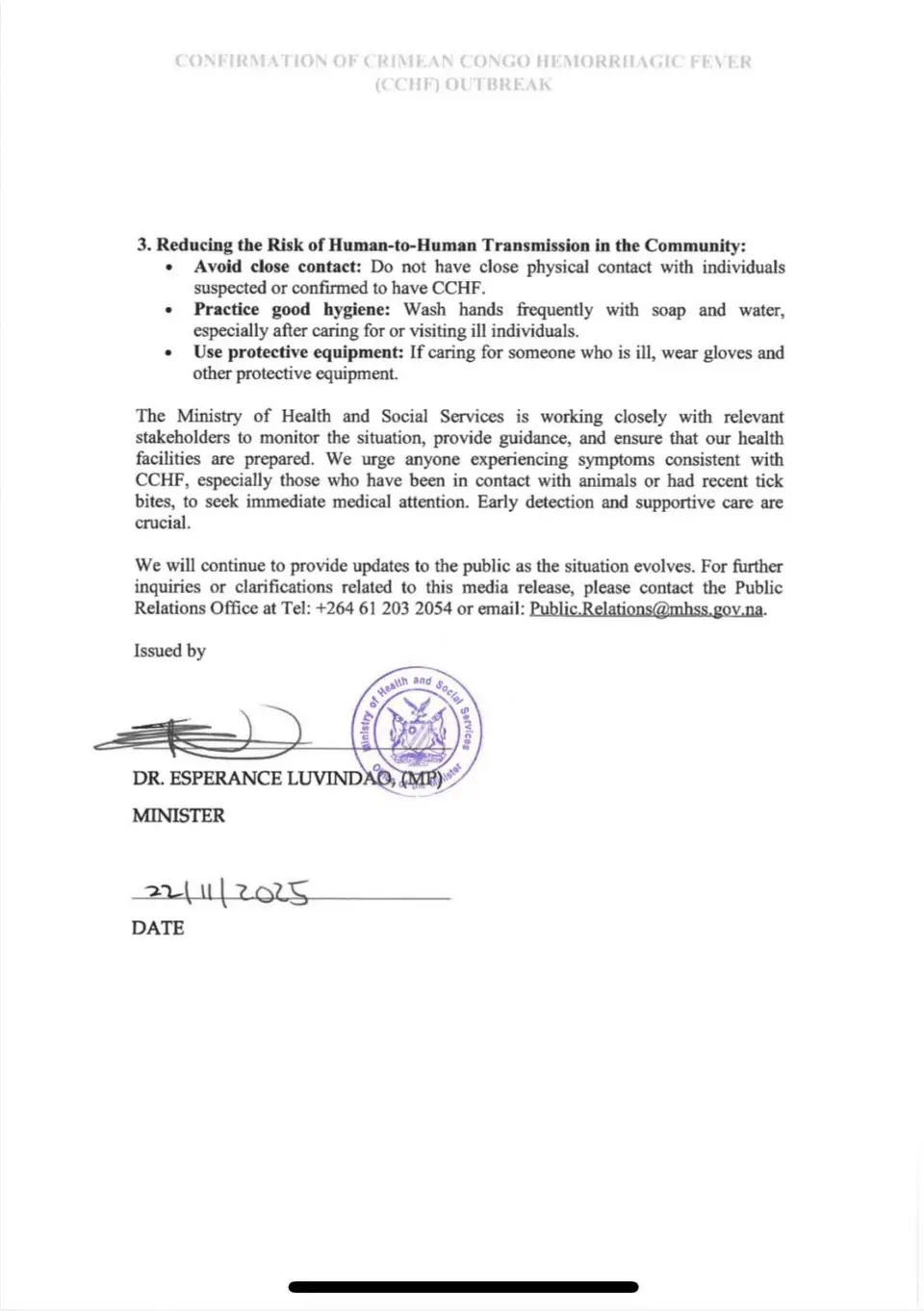
Dazu heute auch im Informante:
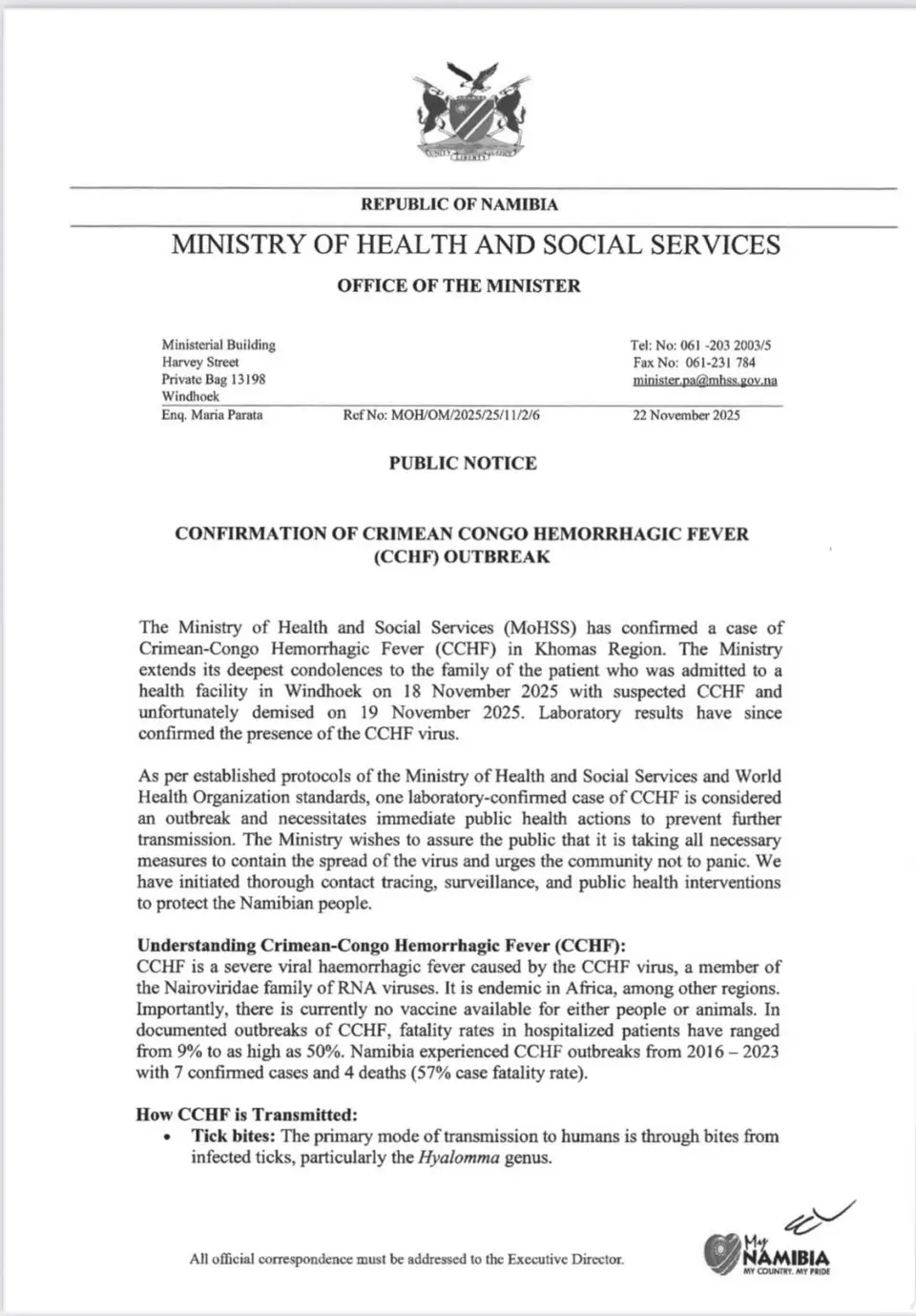
Health Minister announces confirmed case of Crimean-Congo Haemorrhagic FeverGesundheitsminister gibt bestätigten Fall von Krim-Kongo-Hämorrhagischem Fieber bekannt:
Die Gesundheitsministerin, Dr. Esperance Luvindao, hat bekannt gegeben, dass es in der Region Khomas einen bestätigten Fall von Krim-Kongo-Hämorrhagischem Fieber (CCHF) gibt.
„Das Ministerium spricht der Familie des Patienten, der am 18. November 2025 mit Verdacht auf Krim-Kongo-Hämorrhagisches Fieber in eine Gesundheitseinrichtung in Windhoek eingeliefert wurde und leider am 19. November 2025 verstarb, sein tiefstes Beileid aus. Laborergebnisse haben inzwischen das Vorhandensein des Krim-Kongo-Hämorrhagischen Fieber-Virus bestätigt“, erklärte der Minister.
Luvindao erklärte, dass gemäß den etablierten Protokollen des Gesundheitsministeriums und den Standards der Weltgesundheitsorganisation (WHO) ein laborbestätigter Fall von Krim-Kongo-Hämorrhagischem Fieber (CCHF) als Ausbruch gilt. Dies erfordere, so Luvindao, sofortige Maßnahmen des öffentlichen Gesundheitswesens, um eine weitere Ausbreitung zu verhindern.
...
Luvindao erklärte weiter, dass es sich bei CCHF um ein schweres virales hämorrhagisches Fieber handelt, das durch das CCHF-Virus, ein Mitglied der Familie der Nairoviridae, einer Gruppe von RNA-Viren, verursacht wird.
„Die Krankheit ist unter anderem in Afrika endemisch. Wichtig ist, dass es derzeit weder für Menschen noch für Tiere einen Impfstoff gibt. Bei dokumentierten Ausbrüchen des Krim-Kongo-Hämorrhagischen Fiebers (CCHF) lag die Sterblichkeitsrate bei stationär behandelten Patienten zwischen 9 % und 50 %. In Namibia gab es von 2016 bis 2023 CCHF-Ausbrüche mit sieben bestätigten Fällen und vier Todesfällen (Sterblichkeitsrate von 57 %)“, so der Minister.
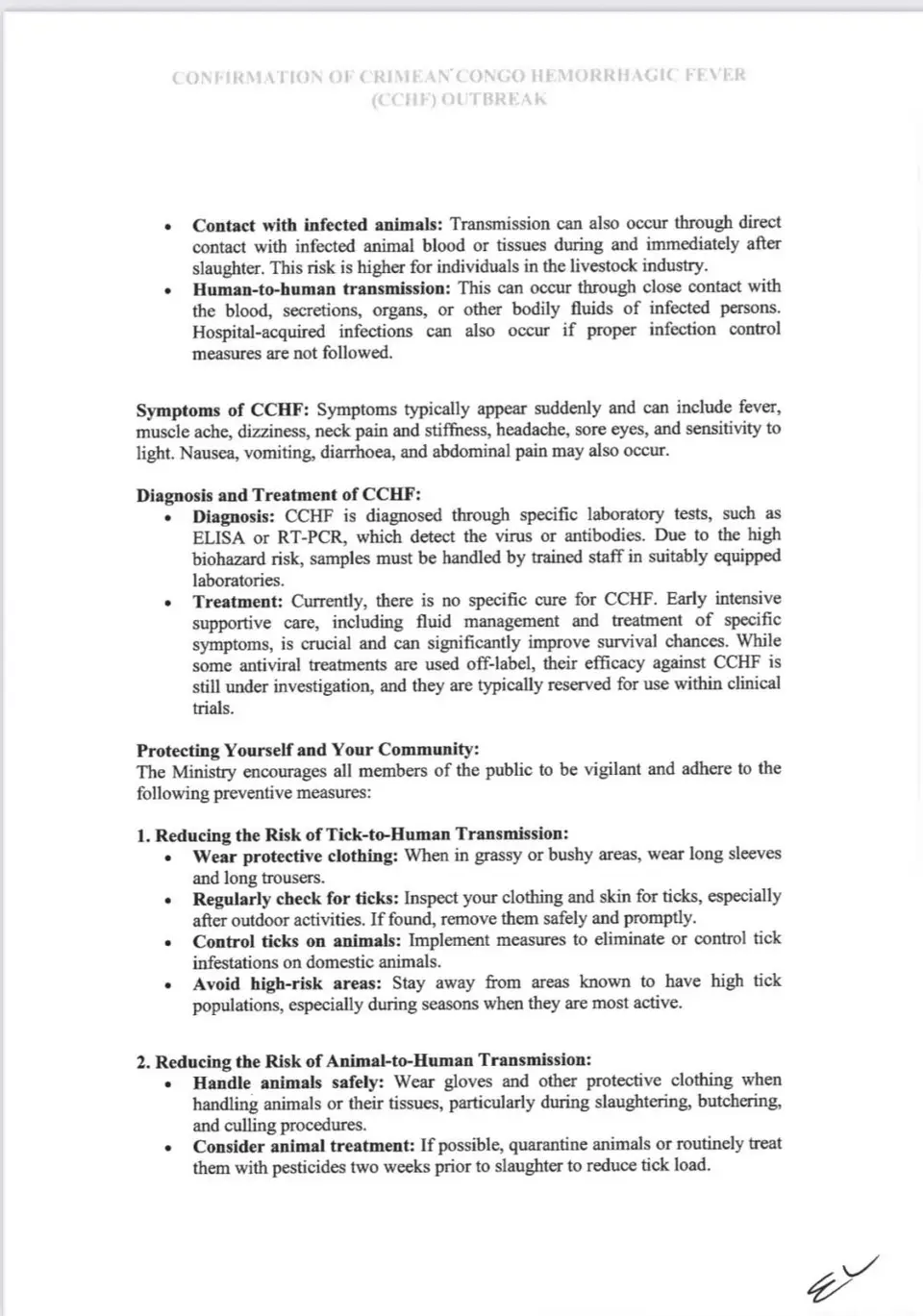
Luvindao betonte, dass das Virus durch Zeckenbisse, Kontakt mit infizierten Tieren und von Mensch zu Mensch übertragen wird. Sie erklärte, dass die Symptome typischerweise plötzlich auftreten und Fieber, Muskelschmerzen, Schwindel, Nackenschmerzen und -steifheit, Kopfschmerzen, Augenreizungen, Lichtempfindlichkeit, Übelkeit, Erbrechen, Durchfall und Bauchschmerzen umfassen können.
...LG
Logi